

Giáo án Tiếng Anh 6 - Tuần 5 - Năm học 2023-2024 - Lê Khánh Ly
I. OBJECTIVES:
1. Knowledge:
- This section aims at helping students use everyday English phrases and expressions and develop their language skills, as well as learn about Vietnamese culture and other cultures.
Students learn how to give suggestions.
+ Vocabulary: use the words related to the topic My house.
+ Grammar:- use possesive case to describe possesion;
- use prepositions of place to describe where people or things are;
- give suggestions;
2. Compentece: By the end of the lesson students will be able to pratice reading and listening the conversation between Mi and Nick about types of rooms and houses. using possesive case to describe possesion; using prepositions of place to describe where people or things are;
3. Quality/ behavior : To teach Ss the love of English, the love of their own room and house ; The knowledge of working in group, individual work, pairwork, cooperative learning and communicative competence.
II. TEACHING AIDS:
- Teacher: Text book, laptop, louspeaker, projector…
- Students : Text books, studying equipments….
- Method;: T-WC; group works; individual ……
 14 trang
31/03/2026
4480
14 trang
31/03/2026
4480
Tóm tắt nội dung tài liệu: Giáo án Tiếng Anh 6 - Tuần 5 - Năm học 2023-2024 - Lê Khánh Ly
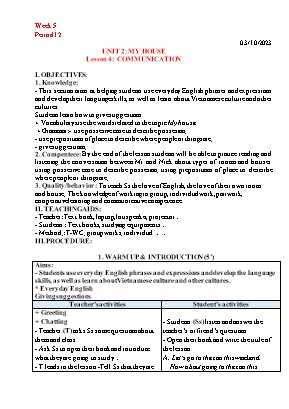
 Week 5
Period 12
 03/10/2023
 UNIT 2: MY HOUSE
 Lesson 4: COMMUNICATION
I. OBJECTIVES:
1. Knowledge:
- This section aims at helping students use everyday English phrases and expressions
and develop their language skills, as well as learn about Vietnamese culture and other
cultures.
Students learn how to give suggestions.
+ Vocabulary: use the words related to the topic My house.
 + Grammar:- use possesive case to describe possesion;
- use prepositions of place to describe where people or things are;
- give suggestions;
2. Compentece: By the end of the lesson students will be able to pratice reading and
listening the conversation between Mi and Nick about types of rooms and houses.
using possesive case to describe possesion; using prepositions of place to describe
where people or things are;
3. Quality/ behavior : To teach Ss the love of English, the love of their own room
and house ; The knowledge of working in group, individual work, pairwork,
cooperative learning and communicative competence.
II. TEACHING AIDS:
- Teacher: Text book, laptop, louspeaker, projector
- Students : Text books, studying equipments.
- Method;: T-WC; group works; individual
III. PROCEDURE:
 1. WARM UP & INTRODUCTION (5’)
Aims:
- Students use everyday English phrases and expressions and develop the language
skills, as well as learn about Vietnamese culture and other cultures.
* Everyday English
Giving suggestions.
 Teacher’s activities Student’s activities
+ Greeting
+ Chatting - Students (Ss) listen and answer the
- Teacher (T) asks Ss some questions about teacher’s or friend’s questions
them and class. - Open their book and write the tittle of
- Ask Ss to open their book and introduce the lesson .
what they are going to study. A. Let’s go to the zoo this weekend.
- T leads in the lesson.- Tell Ss that they are How about going to the zoo this going to learn how to give suggetions . Ask weekend?
Ss to expalin or demostrate how to give B. Great idea.
suggestions.
 2. PRESENTATION/ NEW LESSON (12’)
ACTIVITY 1 + 2:
Aim: Teach Ss how two ways of giving suggestions in English and help Ss
practice giving suggestions.
 Teacher’s activities Student’s activities
1. Elena and her Mum are discussing how to
decorate her bedroom. Listen and read the - T_Ss
dialogue . Pay attention to the highlighted + Students (Ss) listen to the
sentences. instructions carefully and learn how
1. Play the recording for Ss to listen and read the to do the tasks.
dialogue between Elena and her mum at the same -Ss work in groups and Read aloud
time. the dialogue.
Ask Ss to pay attention to the highlighted
 - Ss practise the dialogue in groups.-
sentences.
Elicit the structures of giving suggestions from Ss Ss may use everyday English to talk
{How about + V-ing?, Let's + V). to each other.
Have Ss practise the dialogue in pairs. - Ss work in pairs.
Call on some pairs to practise the dialogue in Audio script:
front of the class. Elena: My bedroom isn't nice.
 Mum: How about putting a picture
2. Work in pairs. Make similar dialogue. on the wall?
Remember to use the structure. Elena: Great idea, Mum.
+ How about + V-ing? Mum: Let's go to the department
+ Let’s + V-Infinitive store to buy one.
- Ask Ss to work in pairs to make similar 2. Work in pairs. Make similar
dialogues, using the structures of giving dialogue
suggestions. - Ask Ss to work in pairs to make
- Observe and help when and where necessary, similar dialogues, using the
and correct Ss'pronunciation and intonation. structures of giving suggestions.
- Comment on their performance. - Work in groups and practise in
- Move around to observe and provide help. pairs
- Call on some groups to practise in front of the + Ss do the tasks
class.
- Comment on their pertormance.
 3. PRACTICE (15’)
ACTIVITY 3: Living places.
Aim: Give Ss a sample of a house description.
 Teacher’s activities Student’s activities
3. Mi tells Nick about her grandparents’ country house .
Look at the pictures of her * Vocabulary: grandparents’house and complete the sentences -hall (n) sảnh
*) Teach vocabulary: - put (v) đặt để
- Teacher uses different techniques to teach vocabulary - store (n) cửa hàng
(situation, realia, translation .....) - wardrobe(n) tủ quần áo
+ Follow the steps to teach vocabulary
- Repeat in chorus and individually
- Take note
- To help Ss practise using some grammar points and
vocabulary related to the topic.
- Have Ss look at the picture and try describing the house.
- Encourage Ss to say full sentences. - Ss work individually
- Then ask Ss to work in pairs to complete the given Suggested answers:
sentences. Key: 1. country2. are
- Move around to observe and provide help. 3. is 4. Chairs
 - Invite Ss to share their answers. 5. On
- Confirm the correct answers.
- Observe and help when and where necessary, and correct
Ss'pronunciation and intonation.
ACTIVITY 4: Help Ss practise asking and answering questions about the different
between two houses.
4. Student A look at the picture of Nick’s house on
this page. Student B looks at the pictures of Mi’s
house on page 25. Ask questions to find the - Listen carefully
differences between the two houses. - Answer questions
- This is a communicative activity called an
 individually.
information gap activity.
- Have Ss work in pairs to find the differences - Work in pairs
between the two houses.
 - Do the tasks
- Before Ss do this activity, model the way to do this
with a student. The conversation could be:
- Ask Ss in each pair not to look at each other's T (look at Nick's house): Nick
picture and make similar conversations. lives in a country house. Where
- Ss should note down the differences between the does Mi live?
two houses. Student (look at Mi's house):
- After a few minutes, the pair which has the most She lives in a town house.
differences wins. T: How many rooms are there
- Ask some pairs to act out the conversation. in Mi's house?
- Other pairs listen and add more differences if there Student: There are six rooms.
are any. What about in Nick's house?
- Check and confirm the correct answers How many rooms are there?
 etc. 4. FURTHER PRACTICE (8’)
ACTIVITY 5: Help Ss practice describing their house.
 Teacher’s activities Student’s
 activities
5. Work in groups. Takes turns to interview the others. Use the
questions above.
- This is a personal sharing task. In this activity Ss are encouraged to - Work in
share their own experiences. pairs to
Give Ss 5 - 7 minutes to draw a simple picture of their house. describe their
Ss then work in pairs to tell each other about their house. houses.
If time allows, T can ask them to note down the differences between
their houses.
Call on some Ss to describe their friend's house to the class.
- Ss may also present the differences between their house and their
friend's.
Other Ss and T listen and give comments.
- Choose some Ss to give a presentation to the class.
 5. WRAP-UP & HOME WORK (2’)
- Summarise the main points.
- Have Ss tell what they have learnt in the lesson.
HOME WORK
- Practice describing their house.
- Do more exercises in workbook.
Week 5
Period 13
 04/10/2023
 UNIT 2: MY HOUSE
 Lesson 5: SKILLS_1/ Reading and Speaking
I. OBJECTIVES:
1. Knowledge:
- To teach reading for general and specific information about houses. Students get
acquainted with a reading skills. To learn how to predict for reading . Also to practice
speaking. To practice describing the rooms.
+ Vocabulary: use the words related to the topic My house.To pronounce the final
sounds /s / and /z/ correctly;
+ Grammar:- use possesive case to describe possesion;
- use prepositions of place to describe where people or things are;
- give suggestions;
2. Competence: By the end of the lesson students will be able to pratice reading and
listening the conversation between Mi and Nick about types of rooms and houses. using possesive case to describe possesion; using prepositions of place to describe
where people or things are;Describing the rooms they have designed.
3. Quality/ behavior : The love of learning English. The love of their own room and
house. Having the good attitude to working in groups, individual work, pairwork,
cooperative learning and working.
II. TEACHING AIDS:
- Teacher: Text book, laptop, louspeaker, projector
- Students : Text books, studying equipments.
- Method;: T-WC; group works; individual
III. PROCEDURE:
 1. WARM UP & INTRODUCTION (3’-5’)
 A ROOM AT THE CRAZY HOUSE HOTEL, DALAT
Aims: Pre - reading
- To develop student’s reading skills for specific information (scanning), It also
provides input for the speaking skills. To provide further practice to support
students in their spoken English.
 Teacher’s activities Student’s activities
+ Greeting
+ Chatting - Students (Ss) listen and answer the
- Teacher (T) asks Ss some questions about teacher’s or friend’s questions
them and class. - Open their book and write the tittle of
- Ask Ss to open their book and introduce the lesson .
what they are going to study.
- T leads in the lesson.
 2. PRESENTATION/ NEW LESSON (12’)
ACTIVITY 1: While- reading
Aim: Get Ss acqainted with a reading skills and help Ss understand and activate
their knowledge of the topic of the lesson.
 Teacher’s activities Student’s activities
1. Look at the text. Answer the questions.
*) Pre- teach vocabulary: * Vocabulary:
- Teacher uses different techniques to teach - crazy (n) lười biếng
vocabulary (situation, realia, translation .....) - shelf (n) giá sách
+ Follow the steps to teach vocabulary - cupboard (n) tủ đựng chén, bát
- Repeat in chorus and individually - strange shape (c/n) hình kì lạ.
+ Check vocabulary Reading skill : Predicting
- Copy all the words - Predicting makes reading easy.
 + Ask ss to read the reading skill box. - Before reading look at the pictures,
- Explain any words that Ss do not know. designed and title.
- Tell Ss that predicting is an important - Describe what the text about.
reading skill that can help them gain a - Think about what you know about general understanding of the text. the topic.
- Now quickly look at the text, the pictures + Students (Ss) listen to the instructions
answer the questions. carefully and learn how to do the tasks.
- Ask for Ss’ answers. - Ss learn how to read the passages.
- Confirm the correct answer to Question 1
 - Give the answer
and
 Key:
- Ask Ss to do the task 1 on page 12.
 1. It’s an email.
- Teacher gives instructions. 2. The text is about Nick’s room at
 - Tell ss to read the three passages quickly the Crazy House Hotel
and check their ideas.
- Set a strick time limit to read .
- T may call Ss to read aloud each paragraph
- Observe and help when and where
necessary.
- Check the answer.
 3. While- reading (15’)
ACTIVITY 2 :
Aim: Help Ss develop the reading skills of reading for specific information
(scanning).
 Teacher’s activities Student’s activities
2. Read the text again and answer the
questions + Ss do the tasks
+ Have Ss read the text in detail to answer - Listen to the teacher’s instructions
the questions.
 carefully and learn how to do.
- Ask Ss how to do this exercis. Explain the
strategies if necessary E.g. Reading the - T_ Ss
questions, underlining the key words, - Check the meaning of the words
locating the key words in the text, and then
reading that part and answering the - Ss work individually first.
questions. Tel Ss to underline part of email - Compare the answers with partners
that help them with answers. Limit the time - Give the answers
for Ss to ensure them read the text quickly.
- Ask Ss to compare their answers in pairs
before they give the answers. *Key:
- Ask ss to show the evidence to support 1. He’s in Da Lat with his parents.
their answers. 2. There are ten rooms.
- Check and confirm the correct answers. 3. Because there’s a big tiger on the
 wall.
 4. It’s under the bed.
ACTIVITY 3:
Aims: Help Ss further develop the skills of reading for specific information
(scanning). 3. Circle the things in the Tiger Room.
- Ask Ss to do the task. - Listen carefully to the instructions
- Ask them to read through the words given - Answer questions individually.
and locate them in the text. If they find a - T_ Ss
similar word in the text, they should circle it - Follow the instructions carefully
in the list. - Find the answer.
- Have Ss time compare the answers - Compare the answers
- Check and confirm the correct answers. *Key :
- Discuss any common errors and provide a window a wardrobe a cooker a
further practice if necessary. cupboard
*Post-Reading a shelf a lamp a desk a
+ Ask Ss what to include when they want to tiger
describe a room in the hotel. Here are some
things:
- Name of the room.
- Reason for the room.
- Position of thing in the room
+ Write these points on board to prepare for
the next activities.
- Call on some Ss to describe.
- Check their pronunciation and intonation.
- Check and confirm the correct answers
 4. FURTHER PRACTICE (8’) Speaking
ACTIVITY 4 + 5 :
Aims: Help Ss prepare ideas for the next activity and provide an opportunity for
Ss to practise describing the hotel room they have designed.
 Teacher’s activities Student’s activities
4. Creat a new room for the hotel. Draw a plan for
the room. - Listen to the teacher’s
Tell each student to create a new room for the hotel and instructions carefully and
draw a plan for the room. follow them.
Set a time limit for Ss to do it. - Work individually
Ask Ss to give the room a name and bear in mind the
 - Choose the answer .
things in the room and their position. Have them quickly
note down these ideas. - Talk in front of the class’
 - Correct mistakes if have .
5. Show your plan to your partner and dscribe it
- Ask Ss to do activity.
- Have Ss work in pairs and show the plan to their partner. - Listen carefully in the
- Ask Ss to take turns to describe their rooms. instructions.
 - Remind Ss to focus on the three points on the board. - Work in pair
- Move around to observe and offer help.
- Call on some Ss to show their plan to the whole class
and describe it.
- T and other Ss listen and vote for the best plan.
Example: This is the Shark Room. There is a big shark - Show the plans
at the door. Thereis a table and a sofa in the middle of
the room .
 5. WRAP-UP & HOME WORK (2’)
* Have Ss summarise what they have learnt in the lesson with two skills.
- If there is time, T can instruct them to draw a mind map to summarise the main
points of the lesson.
* HOME WORK
- Practice describing the room they have designed.
- Do more exercises in workbook.
- Prepare new lesson. Skills 2 Week 5
Period 14
 05/10/2023
 UNIT 2: MY HOUSE
 Lesson 6 : SKILLS_2/ Listening and Writing
I. OBJECTIVES:
1. Knowledge:
- Listening for specific information about the room and furniture in the room. Write an
email to tell Mira, a penfriend about the houses.Students learn how to write an email
to a friend
+ Vocabulary: use the words related to the topic My house.To pronounce the final
sounds /s / and /z/ correctly;
+ Grammar:- use possesive case to describe possesion;
- use prepositions of place to describe where people or things are;
- give suggestions;
2. Competence: By the end of the lesson students will be able to pratice listening for
specific information about the room and furniture in the room. Pracice writing an
email to a penfriend about the houses. Students also learn how to write an email to a
friend or penfriends.
3. Quality/ behavior : The love of learning English. The love of their own room and
house. Having the good attitude to working in groups, individual work, pairwork,
cooperative learning and working.
II. TEACHING AIDS:
- Teacher: Text book, laptop, louspeaker, projector
- Students : Text books, studying equipments.
- Method;: T-WC; group works; individual
III. PROCEDURE:
 1. WARM UP & INTRODUCTION (3’)
Aim: Develop student’s listening skills for specific information. It also provides
input for the writing skills. To learn how to write an email to a friend or penpalls.
 Teacher’s activities Student’s activities
+ Greeting
+ Chatting - T_Ss
- Teacher (T) asks Ss some questions about them and - Students (Ss) listen and
class. answer the teacher’s or
- Ask Ss about the content of the previous lesson. friend’s questions
Describe Nick’s room in the hotel again. - Talk about one school they - Ask Ss to open their book and introduce what they would like to go to.
are going to study. - Open their book and write
- T leads in the lesson. the tittle of the lesson .
 2. PRESENTATION/ NEW LESSON (10’)
ACTIVITY 1: Pre-listening
Aims: Get Ss acqainted with listening skills and help Ss prepare for listening text.
 Teacher’s activities Student’s activities
1. Look at the pictures. Name each of them. Guess
if they are mentioned in the listening text. + Students (Ss) listen to the
- T_Ss instructions carefully and learn
- Ask Ss to look at the pieces of furniture and name how to do the tasks.
them.
*) Pre- teach vocabulary:
- Teacher uses different techniques to teach
vocabulary (situation, realia, translation .....) - Give the answer.
If have new words Key :
- Call on some Ss to read the words out loud. 1. bookself 2. sofa 3.
- Ask some Ss to write the words on the board. desk
- Have Ss guess of these things are mentioned in the 4. clock 5. window
listening text. If they say yes for a thing. Put a tick + Things mentioned in the
next to the word. listening text: bookself, desk,
- Play the recording once for Ss to check their guess. clock, window.
- Encourage Ss to give their answers, but do not
confirm whether their answers right or wrong.
- Let Ss listen once and check their guesses.
 3. While-listening (12’)
ACTIVITY 2 : While-listening
Aim: Help develop Ss' skill of listening for specific information.
 Teacher’s activities Student’s activities 2. Listen to Mai talking about her house.
Tick (✓) T (True) or F (False). - Listen to the teacher’s instructions
- Have Ss look at the sentences. Tell them how carefully and learn how to do it.
to do it. - T_Ss
- Give them some strategies to do the exercise, - Check the meaning if necessary
(e.g. reading the sentences, underlining the key - Give the answers
words, listening to the text paying attention to • Audio script:
the key words, and deciding if each sentence is My name's Mai. I live in a town
 house in Ha Noi. I live with my
true or false).
 parents. There are six rooms in our
- Play the recording twice for the Ss to do house: a living room, a kitchen, two
exercise 2 for stronger classes, ask Ss to take bedrooms, and two bathrooms. I love
notes of the information to explain why a our living room the best because it's
sentence is false. bright. It's next to the kitchen. I have
- Ss can share their answers in pairs my own bedroom. It's small but
- Invite some pairs to give their answers and beautiful. There's a bed, a desk, a
confirm the correct ones. chair, and a bookshelf. It also has a
 big window and a clock on the wall.I
 often read books in my bedroom.
- Play the recording again if needed, stopping
at the place where Ss find it difficult to • Key:
understand. 1. F (There are three people.)
- For stronger classes, ask Ss to correct the 2. F (There are six rooms.)
false sentences. 3.T
- Get feedback. 4.T
- Check and confirm the correct answers. 5. F (She reads books.)
*Post-listening
Students tell about Mai’s house.
- T gives instructions and encourage Ss to tell - Listen to the teacher’s instructions
about Janet’s school, using information in carefully and tell about Mai’s house.
Audio Script.
* Invite one or two Ss to briefly describe Mai's
house, focusing on the type of house, the
number of rooms and her favourite room. - Free talk
- T may give some clues
- Call on some Ss to talk freely.
- Correct pronunciations, grammar, vocab,
intonation.
 Writing (8’)
ACTIVITY 3 : Help Ss brainstorm ideas for their email
- Ss are asked to write an email to tell Mira, a pen friend, about their house.
- Show this sample email on the slide /on the board or give each student a handout with this sample.
- Ask them several questions (e.g. How many parts are there in an email to your
friend? What are they? What should you include when writing each part?).
+ Picture 1: (3)
*T can use the information in this box when expaining how to write an email to Ss.
+ Picture 2: (3)
 Teacher’s & Student’s activities Content
3. Answer the questions
- Let Ss write the email. - Listen carefully to the instructions
- Guide them to write the email + Picture (1) . - T_Ss
- Tell Ss that now they are going to focus on
the body of the email only.
Tell them that answering the guiding
questions is one way to help them
brainstorm as well as organise ideas for
their writing.
- Have Ss answer the questions individually,
encouraging them to write the answers in
full sentences.
- Move around to offer help
*T can use the information in this box when * Ss learn how to write an email to a
 friend.
expaining how to write an email to Ss.
 + Picture (2)
- Invite some ss to share their answers to the
class.
- T Comments on their answers
 4. APPLLICATION (8’)
ACTIVITY 4: Help Ss practise writing an email to their friend telling about their
house.
 Teacher’s activities Student’s activities
4. Use the answers in 3 to write a
paragraph of 40- 50 words about your - Ss work individually.
school. - Write an email
- Ask Ss to write the body of their email - Write themselves. individually. - To: [email protected].
- Ask one or two Ss to write their email on Subject: My house
the board. Dear Mira,
- Other Ss and T comment on the emails on Thanks for your email. Now I’ll tell you
the board. about my house
- T collects some emails to correct at home. My name's Mai. I live in a town
Otherwise, ask Ss to revise their emails at house in Ha Noi. I live with my parents.
home based on the comments given and There are six rooms in our house: a
submit them to T at the next lesson living room, a kitchen, two bedrooms,
- Ask them to pay attention to punctuation, and two bathrooms. I love our living
structures, word choice, linking words, etc. room the best because it's bright. It's
- T goes round helping if necessary. next to the kitchen. I have my own
- Other Ss and T comment on the writing. bedroom. It's small but beautiful. There's
 a bed, a desk, a chair, and a bookshelf. It
 also has a big window and a clock on the
 wall. I often read books in my bedroom.
 What about you? Where do you live?
 Tell me in your next email
 All the best
 5. WRAP-UP & HOME WORK (2’)
- Have Ss summarise what they have learnt with the two skills.
- T can instruct them to draw a mind map to summarise the main points of the lesson.
HOME WORK
- Finish writing an email. Copy in the note books.
- Do more exercises in workbook.
- Prepare new lesson.
File đính kèm:
- giao_an_tieng_anh_6_tuan_5_nam_hoc_2023_2024_le_khanh_ly.docx


