

Giáo án Tiếng Anh 4 - Tuần 10 - Period 37 - Năm học 2023-2024
Step 1: Draw pupils’ attention to the pictures. Ask Where is Viet Nam? and encourage pupils to point to it. Write Viet Nam on the board.
Step 2: Repeat Step 1 for England, Japan, Australia and America.
Step 3: Have pupils complete the activity by writing the name next to each country. Check answers together as a class.
Extension: Nominate pairs of pupils to act out the exchanges
 31 trang
01/04/2026
3240
31 trang
01/04/2026
3240
Bạn đang xem 20 trang mẫu của tài liệu "Giáo án Tiếng Anh 4 - Tuần 10 - Period 37 - Năm học 2023-2024", để tải tài liệu gốc về máy hãy click vào nút Download ở trên
Tóm tắt nội dung tài liệu: Giáo án Tiếng Anh 4 - Tuần 10 - Period 37 - Năm học 2023-2024
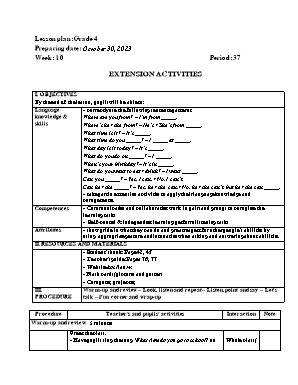
 Lesson plan: Grade 4
 Preparing date: October 30, 2023
 Week: 10 Period: 37
 EXTENSION ACTIVITIES
 I. OBJECTIVES
 By the end of the lesson, pupils will be able to:
 Language - correctly use the following sentence patterns:
 knowledge & Where are you from? – I’m from _____.
 skills Where’s he / she from? – He’s / She’s from _____.
 What time is it? – It’s _____.
 What time do you _____? – I _____ at _____.
 What day is it today? – It’s _____.
 What do you do on _____? – I _____.
 When’s your birthday? – It’s in _____.
 What do you want to eat / drink? – I want _____.
 Can you _____? – Yes, I can. / No, I can’t.
 Can he / she _____? – Yes, he / she can. / No, he / she can’t, but he / she can _____.
 - take part in extension activities to apply their language knowledge and
 competences.
 Competences - Communication and collaboration: work in pairs and groups to complete the
 learning tasks
 - Self-control & independent learning: perform listening tasks
 Attributes - show pride in what they can do and great respect for other people’s abilities by
 using appropriate gesture and intonation when asking and answering about abilities.
 II.RESOURCES AND MATERIALS
 - Student’s book: Page 42, 43
 - Teacher’s guide: Pages 76, 77
 - Website hoclieu.vn
 - Flash cards/ pictures and posters
 - Computer, projector,
 III. Warm-up and review – Look, listen and repeat – Listen, point and say – Let’s
 PROCEDURE talk – Fun corner and wrap-up
 Procedure Teacher’s and pupils’ activities Interaction Note
Warm-up and review: 5 minutes
 Greet the class.
 - Have pupils sing the song What time do you go to school? on Whole class/
 page 19. Praise pupils and get the class to cheer or clap their Individual
 hands. work
 - Ask pupils to open their books at page 42, 43 and look at
 Extension activities, Activity 1.
PRACTICE
Activity 1. Look and write. 5 minutes
a. Goal To identify five different countries in the pictures.
b. Input Five pictures showing the five countries with their flags: Viet Nam, England,
 Japan, Australia, and America.
c. Outcome Pupils can identify five different countries in the pictures.
 Key: 1. Viet Nam 2. England 3. Japan 4. Australia 5. America
d. Procedure Step 1: Draw pupils’ attention to the pictures. Ask Where is Viet Whole class
 Nam? and encourage pupils to point to it. Write Viet Nam on the
 board.
 Step 2: Repeat Step 1 for England, Japan, Australia and Whole class
 America.
 Step 3: Have pupils complete the activity by writing the name
 next to each country. Check answers together as a class. Pair work
 Extension: Nominate pairs of pupils to act out the exchanges.
e. Assessment - Performance products: Student’s answers
 - Assessment tools: Observation; Questions & Answers
PRACTICE
Activity 2. Listen and write. 10 minutes
a. Goal To identify the different times in different countries.
b. Input Five clocks showing the times in five different countries and five gapped
 sentences to complete.
c. Outcome Pupils can identify the different times in different countries and complete the
 gapped sentences.
 Key: 1.8:00 AM 2.1:00 PM 3.7:00 PM 4.9:00 PM 5.10:00 PM
d. Procedure Step 1: Have pupils look at the clocks. Draw their attention to Whole
 the different times in different countries. Explain the concept of class/
 time zones in a simple way if necessary. Individual
 Step 2: Write In America, it’s _____. on the board. Read the work
 first part of the sentence aloud and encourage pupils to complete
 it. When pupils answer correctly, write the answer on the board:
 8:00 AM.
 Step 3: Have pupils complete the activity by completing the
 sentences. Check answers as a class.
e. Assessment - Performance products: Student's talks and interaction
 - Assessment tools: Observation; questions & answers
PRODUCTION
 Activity 3. Read the questions. Then tick the answers. 8 minutes
a. Goal To read the questions and tick the correct answers, then say what countries are
 near / far from Viet Nam.
b. Input Questions and answer options for pupils to choose and tick.
c. Outcome Pupils can read the questions and tick the correct answers, then state what
 countries are near / far from Viet Nam.
 Key: 1. A a B c 2. A a B b
 1. A. It’s Thailand. B. It’s Malaysia. 2. A. It’s Canada. B. It’s Australia.
d. Procedure Step 1: Draw pupils’ attention to Question 1 and read it as a Whole
 class. Check comprehension. class/
 Step 2: Ask pupils to look at Answer A with three answer Individual
 options a, b and c. Explain the new word Russia. Get them to work
 look at the flags of Thailand, America and Russia, elicit the right
 answer and tick it (Picture a). Repeat the same procedure with
 Answer B.
 Step 3: Repeat Steps 1 and 2 with Question 2. Go around the
 classroom to offer support where necessary. Pair work
 Step 4: Get pupils to swap books with a partner, then check
 answers together as a class. Write the correct answers on the Whole
 board for pupils to correct their answers. class/
 Step 5: Have pupils say the answers by asking them Questions 1 Individual
 and 2. work
e. Assessment - Performance products: Student’s interaction and performance
 - Assessment tools: Observation; questions & answers
Fun corner and wrap-up: 5 minutes
 Option 1: Guessing Game Group work
 - Divide the class into 2 teams: Boys and Girls.
 - Pupils take turn to look at the pictures and letters to guess the
 words. If they have the correct answers, they get one point for
 their teams. If the answer is not correct, the other team answer
 and get points.
 Option 2: Mystery box Game Group work
 - Divide the class into two teams: Boys and Girls.
 - Pupils take turns to choose the letter and answer the question.
 - They look at the pictures and answer the questions. If they have
 the correct answers, they get one point for their teams. If the
 answer is not correct, the other team answer and get points.
 - Team with the most points is the winner.
 D. ADJUSTMENTS (if necessary):
 .
.....
...
....
Week: 10 Period: 34
 UNIT 6: OUR SCHOOL FACILITIES
 Lesson 1 (1,2,3)
I. OBJECTIVES
By the end of the lesson, pupils will be able to:
Language - understand and correctly repeat the sentences in two communicative
knowledge & contexts focusing on asking and answering questions about the location of
skills a school.
 - correctly say the words and use Where’s your school? – It’s in the _____.
 to ask and answer questions about the location of a school.
 - enhance the correct use of Where’s your school? – It’s in the ___. to ask
 andanswer questions about the locationof a school in a freer context.
Competences - Communication and collaboration: work in pairs and groups to complete the
 learning tasks
 - Self-control & independent learning: perform listening tasks
Attributes - Show pride in where they’re from and great respect for other people’s
 locations by using appropriate gesture and intonation when asking and
 answering about school locations.
II.RESOURCES AND MATERIALS
 - Student’s book: Page 44
 - Audio tracks 57, 58
 - Teacher’s guide: Pages 87, 88, 89
 - Website hoclieu.vn
 - Flash cards/ pictures and posters (Unit 6)
 - Computer, projector,
 III. Warm-up and review – Look, listen and repeat – Listen, point and say –
 PROCEDURE Let’s talk – Fun corner and wrap-up
 Procedure Teacher’s and pupils’ activities Interaction Note
 Warm-up and review: 5 minutes
 Greet the class.
 Option 1: Whole
 class/
 - Spend a few minutes revising Unit 5 by asking the class
 Individual
 to do the project in .
 Lesson 3 work
 Option 2:
 - Sing the song in Unit 5 - Lesson 2.
EXPLORATION
Activity 1. Look, listen and repeat. 5 minutes
a. Goal To understand and correctly repeat the sentences in two communicative
 contexts focusing on asking and answering questions about the location
 of a school.
b. Input – Context a:
 Hung: Where’s your school, Lucy?
 Lucy: It’s in the city.
 – Context b:
 Lucy: And where’s your school, Hung?
 Hung: It’s in the mountains.
c. Outcome Pupils can understand and correctly repeat the sentences in two
 communicative contexts focusing on asking and answering questions
 about the location of a school.
d. Procedure Step 1: Ask pupils to look at Pictures a and b and guess the Whole
 locations of the schools. class/
 Individual
 Step 2: Ask pupils to look at Picture a. Play the recording
 work
 for them to listen.
 Step 3: Play the recording again, sentence by sentence, for
 pupils to listen and repeat individually and in chorus.
 Correct their pronunciation where necessary. Repeat the
 same procedure with Picture b.
 Step 4: Invite a few pairs to the front of the classroom to
 listen to and repeat the sentences in the recording. Pair work
 Step 5: Draw pupils’ attention to the question Where’s your Whole
 school? and the answers: It's in the city. and It’s in the class/
 mountains. Tell pupils that they are a question and answers Individual
 about the location of a school. work
e. - Performance products: Student’s answers
Assessment - Assessment tools: Observation; Questions & Answers
KNOWLEDGE CONSTRUCTION
Activity 2. Listen, point and say. 10 minutes
a. Goal To correctly say the words and use Where’s your school? – It’s in the
 _____. to ask and answer questions about the location of a school.
b. Input – Picture cues:
 a. a school in the mountains
 b. a school in the village
 c. a school in the city
 d. a school in the town
 – Speech bubbles: Where’s your school? – It’s in the _____.
 Audio script:
 a. mountains b. village c. city d. town
 a. A: Where’s your school?
 B: It’s in the mountains.
 b. A: Where’s your school?
 B: It’s in the village.
 c. A: Where’s your school?
 B: It’s in the city.
 d. A: Where’s your school?
 B: It’s in the town.
c. Outcome Pupils can correctly say the words and use Where’s your school? – It’s
 inthe _____. to ask and answer questions about the location of a school.
d. Procedure Step 1: Have pupils look at the pictures and elicit the Whole
 locations of schools. class/
 Individual
 Step 2: Have pupils point at Picture a (mountains), listen
 work
 to the recording and repeat the word (mountains). Repeat
 the same procedure with Pictures b, c and d. Have the class
 repeat the words a few times.
 Step 3: Point at the first bubble and have pupils listen to
 and repeat after the recording (Where’s your school?).
 Point at Picture a and have pupils listen to and repeat after
 the recording (It’s in the mountains.). Repeat the same
 procedure with the other three pictures.
 Step 4: Divide the class into two groups to take turns
 repeating the question and the answer in Picture a until Group
 they feel confident. Repeat the same procedure with work
 Pictures b,c and d.
 Step 5: Put pupils in pairs and have them practise asking
 and answering with the pictures. Invite a few pairs to point
 at the pictures and say the questions and answers in front Pair work
 of the class. Correct their pronunciation where necessary.
e. - Performance products: Student's talks and interaction
Assessment - Assessment tools: Observation; Answer keys
PRACTICE
Activity 3. Let’s talk. 8 minutes
a. Goal To enhance the correct use of Where’s your school?– It’s in the ___. to
 ask and answer questions about the location of a school in a freer context.
b. Input – Picture cues: some paintings of schools; the boy painting one of them
 and talking with the girl
 – Speech bubbles: Where’s your school? – _____.
c. Outcome Pupils can enhance the correct use of Where’s your school? – It’s in the
 _____. to ask and answer questions about the location of a school in a
 freer context.
d. Procedure Step 1: Draw pupils’ attention to the two speech bubbles. Whole
 Read the question aloud and ask pupils to repeat it. Ask class/
 pupils to look at the second bubble and identify what the Individual
 answer should be. Give an example answer It’s in work
 thevillage. Get pupils to repeat the question and the answer
 several times.
 Step 2: Have pairs of pupils practise asking and answering Pair work
 questions about the locations of the schools in the paintings.
 Go around the classroom to observe and provide help.
 Step 3: Invite some pairs to practise asking and answering Pair work
 questions about the locations of the schools in front of the
 class and correct their pronunciation where necessary.
e. - Performance products: Student’s interaction and performance
Assessment - Assessment tools: Observation; Questions & Answers
Fun corner and wrap-up: 5 minutes
 Option 1: Doraemon Game (ppt) Group
 work
 - Divide the class into 3 teams.
 - Pupils from each team choose a letter, then answer the
 question.
 - Pupils answer correctly to get some points corresponding
 to the number of pies.
 Option 2: Whole
 - Ask students to answer the following questions: class/
 Individual
 1.
 What have you learnt from the lesson today? work
 (Use Where’s your school? – It’s in the ___. to ask and
 answer questions about the location of a school.)
 2. What are the core values of the lesson?
 (Show pride in where they’re from and great respect for
 other people’s locations by using appropriate gesture and
 intonation when asking and answering about school
 locations.)
 * Preparation for the project:
 Ask pupils to prepare for the project on page 49 by drawing
 their school and its facilities as homework so that they can
 tell the class about their school at Project time.
 D. ADJUSTMENTS (if necessary):
.
.....
...
....
Week: 10 Period: 39
 UNIT 6: OUR SCHOOL FACILITIES
 Lesson 1 (4,5,6)
I. OBJECTIVES
By the end of the lesson, pupils will be able to:
Language - listen to and understand four communicative contexts in which pupils ask
knowledge & and answer questions about school locations and number the correct
skills pictures.
 - complete four target gapped exchanges with the help of picture cues.
 -review the words of locations by playing the game Matching pairs.
Competences - Communication and collaboration: work in pairs and groups to complete the
 learning tasks
 - Self-control & independent learning: perform listening tasks
Attributes - Show pride in where they’re from and great respect for other people’s
 locations by using appropriate gesture and intonation when asking and
 answering about school locations.
II.RESOURCES AND MATERIALS
 - Student’s book: Page 45
 - Audio track 59
 - Teacher’s guide: Pages 89, 90, 91
 - Website hoclieu.vn
 - Flash cards/ pictures and posters (Unit 6)
 - Computer, projector,
III. Warm-up and review – Listen and number – Look, complete and read –
PROCEDURE Let’s play – Fun corner and wrap-up
 Procedure Teacher’s and pupils’ activities Interaction Note
 Warm-up and review: 5 minutes
 Greet the class.
 Option 1:
 - Spend a few minutes revising the sentence patterns Whole
 Where’s your school? – It’s in the _____. Have pupils ask class/
 and answer questions about the locations of schools in Individual
 front of the class. work
 Option 2: Group work
 - Dictate some sentences about locations (e.g. My school
 is in the mountains.) and ask pupils to write them down.
 Then let them work in pairs or groups to correct each
 other’s answer.
 Option 3:
 - Play Open the card game (ppt).
PRACTICE
Activity 4. Listen and number. 5 minutes
a. Goal To listen to and understand four communicative contexts in which pupils
 ask and answer questions about school locations and number the correct
 pictures.
b. Input Picture cues:
 a. a school in the city
 b. a school in the village
 c. a school in the town
 d. a school in the mountains
 Audio script:
 1. A: Where’s your school?
 B: It’s in the town.
 2. A: Where’s your school?
 B: It’s in the mountains.
 3. A: Where’s your school? Is it in the city?
 B: Yes, it is. It’s in the city.
 4. A: Is your school in the mountains?
 B: No. It’s in the village.
c. Outcome Pupils can listen to and understand four communicative contexts in which
 pupils ask and answer questions about school locations and number the
 correct pictures.
 Key:1. c 2. d 3. a 4. b
d. Procedure Step 1: Have pupils look at Activity 4. Ask them How many Whole
 pictures are there? and What can you see in each picture? class/
 Draw pupils’ attention to the boxes in the corners of the Individual
 pictures. Check their comprehension. work
 Step 2: Play the recording of the first dialogue. Tell pupils
 that they will need to listen to the location (e.g. city, village,
 town, mountains). Ask pupils Where’s the school? Help
 pupils find out the answer of the location in the dialogue.
 Then ask pupils in which picture the location town appears
 (Picture c). Tell pupils to write “1” in the box of Picture c.
 Step 3: Play the recording of the other dialogues and allow Pair work
 pupils to write down their answers. Give pupils some
 minutes to swap books with a partner and then check the
 answers as a class. Correct the answers where necessary.
 Whole
 Extension: If time allows, play the recording, sentence by class/
 sentence, for the class to listen and repeat individually and Individual
 in chorus. Correct their pronunciation if necessary. work
e. - Performance products: Student’s answers
Assessment - Assessment tools: Observation; Questions & Answers
PRACTICE
Activity 5. Look, complete and read. 10 minutes
a. Goal To complete four target gapped exchanges with the help of picture cues.
b. Input Four picture cues and four target gapped exchanges
c. Outcome Pupils can complete four target gapped exchanges with the help of
 picture cues.
d. Procedure Step 1: Ask pupils to look at the pictures and identify the Whole
 school locations in the four pictures. class/
 Individual
 Step 2: Ask pupils to look at the incomplete exchanges.
 work
 Draw their attention to the missing words in the sentences.
 Step 3: Model Picture 1. Have pupils look at the dialogue.
 Ask them what is missing in the answer (village). Then,
 have them fill the gap. Repeat the same procedure with
 Pictures 2, 3 and 4.
 Step 4: Get pupils to complete the exchanges individually, Individual
 then ask a few pairs to read them aloud and check their work/
 pronunciation if necessary. Pair work
e. - Performance products: Student's talks and interaction
Assessment - Assessment tools: Observation; Answer keys
PRODUCTION
Activity 6. Let’s play. 8 minutes
a. Goal To review the words of locations by playing the game Matching pairs.
b. Input Four picture cards showing school locations and four word cards showing
 the words mountains, village, city and town
c. Outcome Pupils can review the words of locations by playing the game
 Matchingpairs.
d. Procedure Step 1: Tell pupils that they are going to find four pairs of Whole
 pictures and words as quickly as possible. class/
 Individual
 Step 2: Stick the picture cards face down in the left column
 work
 on the board. Stick the word cards face down in the right
 column on the board.
 Step 3: Invite one pupil to play the game by selecting a Individual
 picture card and a word card, turning them over. If two work
 cards are a matching pair, ask the pupil to say the word
 aloud. The pupil can continue to take another turn. If the
 cards do not make a match, ask the pupil to turn them face
 down again, and invite another pupil to take the next turn.
 Step 4: Let pupils play the game until all pairs have been
 matched. Play the game several times if there is enough Pair work
 time.
e. - Performance products: Student’s interaction and performance
Assessment - Assessment tools: Observation; Questions & Answers
Fun corner and wrap-up: 5 minutes
 Option 1: Matching Pair Game (ppt) Group
 work
 - Divide the class into 3 teams.
 - Pupils from each team choose two numbers to find out the
 matching pair.
 - Pupils answer correctly and get one point.
 - The team that gets the most points is the winner.
 Option 2: Whole
 class/
 - Ask students to answer the following questions:
 Individual
 1.
 What have you learnt from the lesson today? work
 (Use Where’s your school? – It’s in the ___. to ask and
 answer questions about the location of a school.)
 2. What are the core values of the lesson?
 (Show pride in where they’re from and great respect for
 other people’s locations by using appropriate gesture and
 intonation when asking and answering about school
 locations.)
D. ADJUSTMENTS (if necessary):
.
.....
...
....
Week: 10 Period: 40
 UNIT 6: OUR SCHOOL FACILITIES
 Lesson 2 (1,2,3)
I. OBJECTIVES
By the end of the lesson, pupils will be able to:
Language - understand and correctly repeat the sentences in two communicative
knowledge & contexts focusing on asking and answering questions about the quantity of
skills school facilities.
 - correctly say the phrases and use How many ____ are there at your
 school? – There is ___. / There are ____. to ask and answer questions
 about the quantity of school facilities.
 - enhance the correct use of How many ___ are there at your school? and
 There is ____. / There are ____. to ask and answer questions about the
 quantity of school facilities in a freer context.
 Competences - Communication and collaboration: work in pairs and groups to complete the
 learning tasks
 - Self-control & independent learning: perform listening tasks
 Attributes - Show pride and responsibility in the facilities they have at their school.
 II.RESOURCES AND MATERIALS
 - Student’s book: Page 46
 - Audio tracks 60, 61
 - Teacher’s guide: Pages 92, 93, 94
 - Website hoclieu.vn
 - Flash cards/ pictures and posters (Unit 6)
 - Computer, projector,
 III. Warm-up and review – Look, listen and repeat – Listen, point and say –
 PROCEDURE Let’s talk – Fun corner and wrap-up
 Procedure Teacher’s and pupils’ activities Interaction Note
 Warm-up and review: 5 minutes
 Greet the class.
 Option 1: Whole
 class/
 - Spend a few minutes revising Lesson 1 by playing the
 Individual
 game Matching pairs.
 work
 Option 2: Group work
 - Play the Guessing game (ppt).
EXPLORATION
Activity 1. Look, listen and repeat. 5 minutes
a. Goal To understand and correctly repeat the sentences in two communicative
 contexts focusing on asking and answering questions about the quantity
 of school facilities.
 b. Input – Context a:
 Linh: Where’s your school, Bill?
 Bill: It’s in the town.
 – Context b:
 Linh: How many buildings are there at your school?
 Bill: There are three.
c. Outcome Pupils can understand and correctly repeat the sentences in two
 communicative contexts focusing on asking and answering questions
 about the quantity of school facilities.
d. Procedure Step 1: Get pupils to look at Pictures a and b and identify Whole
 the characters in the pictures. Get them to say what they can class/
 see in the background. Individual
 Step 2: Ask pupils to look at Picture a. Play the recording work
 for them to listen.
 Step 3: Play the recording again, sentence by sentence, for
 pupils to listen and repeat individually and in chorus.
 Correct their pronunciation where necessary. Repeat the
 same procedure with Picture b.
 Step 4: Invite a few pairs to the front of the classroom to Pair work
 listen to and repeat the sentences in the recording. Correct
 their pronunciation where necessary.
 Step 5: Draw pupils’ attention to the question How Whole
 manybuildings are there at your school? and the answer class/
 There arethree. Tell pupils that this is a question and an Individual
 answer about the quantity of school facilities. work
e. - Performance products: Student’s answers
Assessment - Assessment tools: Observation; Questions & Answers
KNOWLEDGE CONSTRUCTION
Activity 2. Listen, point and say. 10 minutes
a. Goal To correctly say the phrases and use How many ____ are there at your
 school? – There is ___. / There are ____. to ask and answer questions
 about the quantity of school facilities.
b. Input – Picture cues:
 a.playgrounds/ one
 b. computer rooms/ two
 c. gardens/ one
 d. buildings/ three
 – Speech bubbles:
 How many ___ are there at your school? – There is ___. / There are ___.
 Audio script:
 a.playgrounds/ one b.computer rooms/ two
 c.gardens/ one d.buildings/ three
 a. A: How many playgrounds are there at your school?
 B: There is one.
 b. A: How many computer rooms are there at your school?
 B: There are two.
 c. A: How many gardens are there at your school?
 B: There is one.
 d. A: How many buildings are there at your school?
 B: There are three.
c. Outcome Pupils can correctly say the words and phrases and use Where’s your
 school? –It’s in the _____. to ask and answer questions about the
 quantities of school facilities.
 d. Procedure Step 1: Have pupils point at Picture a, listen to the Whole
 recording and repeat the phrase (playgrounds/ one). Repeat class/
 the same procedure with Pictures b, c and d. Have the class Individual
 repeat the phrases a few times. work
 Step 2: Point at the question pattern How many ___ are
 there at your school? Read it aloud and have pupils repeat
 it. Repeat the same procedure with the answer patterns
 There is ___. and There are ___.
 Step 3: Point at Picture a and have pupils listen to and
 repeat after the recording How many playgrounds are
 there at your school? – There is one. Repeat the same
 procedure with Pictures b, c and d.
 Step 4: Divide the class into two groups to take turns Group
 repeating the question and the answer in Picture a until work
 they feel confident. Repeat the same procedure with
 Pictures b, c and d.
 Step 5: Put pupils into pairs and have them practise asking Whole
 and answering the questions. Invite a few pairs to point at class/ Pair
 the pictures and say the questions and answers in front of work
 the class. Correct their pronunciation where necessary.
e. - Performance products: Student's talks and interaction
Assessment - Assessment tools: Observation; Answer keys
PRACTICE
Activity 3. Let’s talk. 8 minutes
a. Goal To enhance the correct use of How many ___ are there at your school?
 and There is ____. / There are ____. to ask and answer questions about
 the quantity of school facilities in a freer context.
b. Input – Picture cue: a school with two buildings, a playground, a computer
 room and a garden
 – Speech bubbles: How many ___ are there at your school? – _____.
c. Outcome Pupils can enhance the correct use of How many ___ are there at your
 school? and There is ___. / There are ____. to ask and answer questions
 about the quantity of school facilities in a freer context.
d. Procedure Step 1: Draw pupils’ attention to the picture. Ask questions Whole
 to help them identify the context (see Input). class/
 Individual
 Step 2: Elicit the missing words in the speech bubbles and
 work
 write them on the board. Get pupils to say the completed
 sentences.
 Step 3: Have pairs of pupils practise asking and answering Pair work
 the questions about the quantity of school facilities in the
 picture. Go around the classroom to observe and provide
 help.
 Step 4: Invite some pairs to practise asking and answering
 questions about the quantity of school facilities in front of
 the class. Give them corrections and feedback where
 necessary.
e. - Performance products: Student’s interaction and performance
Assessment - Assessment tools: Observation; Questions & Answers
Fun corner and wrap-up: 5 minutes
 Option 1: Flowers Game (ppt) Group
 work
 - Divide the class into 3 teams.
 - Pupils from each team choose a number, then answer the
 question.
 - Pupils answer correctly and get some points depending on
 the flower number they choose.
 Option 2: Whole
 - Ask students to answer the following questions: class/
 1. What have you learnt from the lesson today? Individual
 work
 (- UseHow many ___ are there at your school? – There is
 ___. / There are ___. to ask and answer questions about the
 quantity of school facilities.
 - Listen to and demonstrate understanding of simple
 communicative contexts in relation to the topic “Our
 school facilities”.)
 2. What are the core values of the lesson?
 (Show pride and responsibility in the facilities they have at
 their school.)
 D. ADJUSTMENTS (if necessary):
 .
 .....
 Lesson plan: Grade 5
Preparing date: October 30, 2023
Week: 10 Period: 37
 UNIT 6: HOW MANY LESSONS DO YOU HAVE TODAY?
 Lesson 1: Part 4, 5, 6
I. OBJECTIVES
1. Language focus/ Knowledge:
 - Vocabulary: review
 - Sentence patterns:review
2. Competences:
 + Listen and tick the correct pictures about quantity with ‘how many’
 + Reading and completing about quantity with ‘how many’ by filling the missing
words of the text.
 +Sing the song: how many lessons do you have today?
3. Attitude:
 -Actively participate in activities with their classmates in pairs, groups or class.
Educate Ss to know about quantity with ‘how many’.
II. TEACHING AIDS:
 - Pictures, E- book, computer , projector, pictures, recording.
III. PROCEDURE:
 TEACHER’S ACTIVITIES STUDENTS’ACTIVITIES
 Activity 1:Warm –up: Play game:
 Brainstorming(5’)
 *Aim:help ss to remember vocabulary
 that they learnt , feel eager and happy
 with the new lesson.
 -Vocabulary: the subjects at school.
 *Procedure:
 -T tells ss what they have to play game. -SS listen.
 - SS play game in two teams.
 -Have SS play game in two teams.
 -T counts the points for each team,
 announces the winner and gives
 compliment.
 - T links to the new lesson.
 Activity 2:Listen and tick ( 8’)
*Aim: help ss to improve listening skill
about quantity with ‘how many’.
*Procedure:
- Have sslook at the sentences. Tell ssthat - Indentify and guess the answer
they are going to listen to the recording
and tick the timetable in their books.
- Play the recording 2 times. - Ss listen &tick the correct
- Play the recording again sscheck their pictures.Check their guess.
answer - Listen and check
- Ask some questions to ensure ss’ *Keys:
comprehension of the listening text. Long: Maths, IT, Science
*Outcome: SS can improve listening skill Minh: Science, Music, Art and IT
about quantity with ‘how many’. Lan: Vietnamese, Maths, IT and PE
Activity 3: Read and complete (10’)
*Aim: help ss to improve writing
skillsaboutquantity with ‘how many’.
*Procedure:
 - Look and listen.
- Tell ss that they are going to read the
text and fill the gaps with Art, four,
lessons, Wednesday, and Tuesday..
 - SS do the task.
-Give ss time to do the task
 - SS check the answer
independently.
- Ask ss to check their answer
 -Some ss read aloud the complete
- Call some ss read aloud the complete
 answer
answer
 *Keys:
*Outcome: SS can improve writing
 1. Tuesday 2. Lessons
skillsaboutquantity with ‘how many’. 3. Wednesday 4. four 5. Art
Activity 4: Let’s sing (9’)
*Aim:help ss practise singing the song:
how many lessons do you have today?
*Procedure:
 Introduce the song:“how many lessons do - SS listen.
you have today?”
- Play the recording for ss to listen to the
File đính kèm:
- giao_an_tieng_anh_4_tuan_10_period_37_nam_hoc_2023_2024.docx


