

Giáo án Tiếng Anh 4 - Tuần 17 - Period 65 - Năm học 2023-2024
Step 1: Have pupils look at the pictures. Get them to identify the characters and the places in the pictures.
Step 2: Have pupils look at the two gapped exchanges. Draw their attention to the missing words in the questions and answers.
Step 3: Model Exchange 1. Have pupils look at the first gap. Ask them what word is missing (London). Then have them complete the answer (I was in London.). Get them to guess the missing word in the second answer (Yes) and complete the answer (Yes, it is.).
Step 4: Repeat the same procedure with Exchange 2.
Step 5: Have pupils complete the gaps individually. Check their answers as a class and ask a few pairs to read them aloud
 37 trang
01/04/2026
3580
37 trang
01/04/2026
3580
Bạn đang xem 20 trang mẫu của tài liệu "Giáo án Tiếng Anh 4 - Tuần 17 - Period 65 - Năm học 2023-2024", để tải tài liệu gốc về máy hãy click vào nút Download ở trên
Tóm tắt nội dung tài liệu: Giáo án Tiếng Anh 4 - Tuần 17 - Period 65 - Năm học 2023-2024
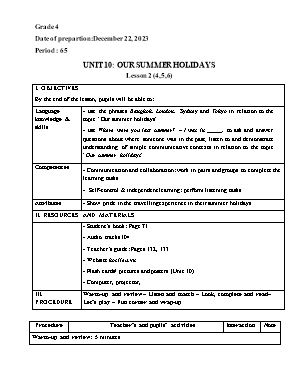
 Grade 4
Date of prepartion: December 22, 2023
Period : 65
 UNIT 10: OUR SUMMER HOLIDAYS
 Lesson 2 (4,5,6)
I. OBJECTIVES
By the end of the lesson, pupils will be able to:
Language - use the phrases Bangkok, London, Sydney and Tokyo in relation to the
knowledge & topic “Our summer holidays”
skills - use Where were you last summer? – I was in _____. to ask and answer
 questions about where someone was in the past; listen to and demonstrate
 understanding of simple communicative contexts in relation to the topic
 “Our summer holidays”.
Competences - Communication and collaboration: work in pairs and groups to complete the
 learning tasks
 - Self-control & independent learning: perform listening tasks
Attributes - Show pride in the travelling experience in their summer holidays
II. RESOURCES AND MATERIALS
 - Student’s book: Page 71
 - Audio tracks 104
 - Teacher’s guide: Pages 132, 133
 - Website hoclieu.vn
 - Flash cards/ pictures and posters (Unit 10)
 - Computer, projector,
III. Warm-up and review – Listen and match – Look, complete and read–
PROCEDURE Let’s play – Fun corner and wrap-up
Procedure Teacher’s and pupils’ activities Interaction Note
Warm-up and review: 5 minutes Greet the class.
 - Spend a few minutes revising the previous lesson by Whole
 getting a few pairs to ask and answer questions about class/
 where someone was in the past. Individual
 – Ask pupils to open their books at page 70 and look at work
 Unit 10, Lesson 2, Activity 4.
EXPLORATION
Activity 4. Listen and match. 5 minutes
a. Goal To listen to and understand four communicative contexts about where
 someone was in the past and match the correct pictures.
b. Input Picture cues:
 1. Mai 2. Bill 3. Mary 4. Nam
 a. Tokyo Tower
 b. Big Ben
 c. Temple of the Golden Buddha
 d. Opera House
 Audio script:
 1. A: Where were you last summer, Mai?
 B: I was in Sydney.
 2. A: Where were you last summer, Bill?
 B: I was in Bangkok.
 3. A: Where were you last summer, Mary?
 B: I was in Tokyo.
 4. A: Where were you last summer, Nam?
 B: I was in London.
c. Outcome Pupils can listen to and understand four communicative contexts about
 where someone was in the past and match the correct pictures. d. Procedure Step 1: Draw pupils’ attention to the characters and Whole
 pictures. Ask questions to help pupils identify the class/
 characters and the places. Individual
 Step 2: Play the recording for pupils to listen. Play the work
 recording again for them to do the task by matching the
 characters to the correct places. Play the recording a third
 time to give pupils another listening opportunity.
 Step 3: Check answers together as a class. Play the
 recording again for pupils to double check their answers.
 Extension: If time allows, play the recording again,
 sentence by sentence, for the class to listen and repeat
 individually and in chorus. Correct their pronunciation
 where necessary.
e. - Performance products: Student’s answers
Assessment - Assessment tools: Observation; Questions & Answers
KNOWLEDGE CONSTRUCTION
Activity 5. Look, complete and read. 10 minutes
a. Goal To complete two gapped dialogues with the help of picture cues.
b. Input – Two picture cues
 – Two gapped exchanges to complete
c. Outcome Pupils can complete two gapped exchanges with the help of picture
 cues. d. Procedure Step 1: Have pupils look at the pictures. Get them to Whole
 identify the characters and the places in the pictures. class/
 Step 2: Have pupils look at the two gapped exchanges. Individual
 Draw their attention to the missing words in the questions work
 and answers.
 Step 3: Model Exchange 1. Have pupils look at the first
 gap. Ask them what word is missing (London). Then have
 them complete the answer (I was in London.). Get them to
 guess the missing word in the second answer (Yes) and
 complete the answer (Yes, it is.).
 Step 4: Repeat the same procedure with Exchange 2.
 Step 5: Have pupils complete the gaps individually. Check Whole
 their answers as a class and ask a few pairs to read them class/ Pair
 aloud work
e. - Performance products: Student's talks and interaction
Assessment - Assessment tools: Observation; Answer keys
PRACTICE
Activity 6. Let’s play. 8 minutes
a. Goal To review target words to make sentences about where someone was in
 the past by playing the game Making sentences.
b. Input Some flash cards of the target vocabulary: I, you, in, London, Sydney,
 Tokyo, where, were, was, last, summer, weekend, yesterday, etc,
c. Outcome Pupils can review target words to make sentences about where someone
 was in the past by playing the game Making sentences. d. Procedure Step 1: Tell pupils that they are going to play the game Whole
 Making sentences in groups of four or five. class/
 Step 2: Nominate one pupil in each group as a leader. The Individual
 leader says a sentence and the other group members have to work
 stand in a line, holding the word cards to make a sentence.
 For example: Where were you last summer?
 Step 3: Set a time limit for the groups to play the game.
 Step 4: Invite two groups to the front of the class to play
 the game. Group
 Step 5: Have the class give comments and announce the work
 winner. The group that makes the most correct sentences
 will win.
e. - Performance products: Student’s interaction and performance
Assessment - Assessment tools: Observation; Questions & Answers
Fun corner and wrap-up: 5 minutes Option 1: Game (ppt) Group
 - Divide the class into 3 teams. work
 - Pupils from each team choose a number, then answer the
 question
 - Pupils answer correctly and get some points.
 Option 2: Whole
 - Ask students to answer the following questions: class/
 Individual
 1. What have you learnt from the lesson today? work
 - use the phrases Bangkok, London, Sydney and Tokyo in
 relation to the topic “Our summer holidays”
 - use Where were you last summer? – I was in _____. to ask
 and answer questions about where someone was in the past;
 - listen to and demonstrate understanding of simple
 communicative contexts in relation to the topic “Our
 summer holidays”.
 2. What are the core values of the lesson?
 - Show pride in the travelling experience in their summer
 holidays.
IV. COMMENT
. Period: 66
 UNIT 10: OUR SUMMER HOLIDAYS
 Lesson 3 (1,2,3)
I. OBJECTIVES
By the end of the lesson, pupils will be able to:
Language - correctly pronounce the sounds of the letters ere in isolation, in the words
knowledge & were and where, and in the sentences Were you on the beach last summer?
skills and Where were you last weekend?;
 - use the phrases at the campsite, at the zoo, in the countryside, on the
 beach, Bangkok, London, Sydney and Tokyo in relation to the topic “Our
 summer holidays”
 - listen to and demonstrate understanding of simple communicative
 contexts in relation to the topic “Our summer holidays”.
Competences - Communication and collaboration: work in pairs and groups to complete the
 learning tasks
 - Self-control & independent learning: perform listening tasks
Attributes - Show pride in the travelling experience in their summer holidays
II. RESOURCES AND MATERIALS
 - Student’s book: Page 72
 - Teacher’s guide: Pages 134, 135
 - Website hoclieu.vn
 - Flash cards/ pictures and posters (Unit 10)
 - Computer, projector,
III. Warm-up and review – Listen and repeat – Listen and circle – Let’s
PROCEDURE chant – Fun corner and wrap-up
Procedure Teacher’s and pupils’ activities Interaction Note
Warm-up and review: 5 minutes Greet the class.
 Option 1: Whole
 - Sing and dance to the Freeze and Fire song. class/
 Individual
 Option 2: work
 - Spend a few minutes revising the previous lesson by
 asking pupils to play the game Board race using the
 language learnt.
 - Ask pupils to open their books at page 32 and look at
 Unit 4, Lesson 3, Activity 1.
EXPLORATION
Activity 1. Listen and repeat. 5 minutes
a. Goal To correctly repeat the sounds of the letters ere in isolation, in the words
 were and where, and in the sentences Were you on the beach last
 summer? and Where were you last weekend? with the correct
 pronunciation and intonation.
b. Input – The letters ere, the word were and the sentence Were you on the beach
 last summer?
 – The letters ere, the word where and the sentence Where were you last
 weekend?
c. Outcome Pupils can correctly repeat the sounds of the letters ere in isolation, in the
 words were and where, and in the sentences Were you on the beach last
 summer? and Where were you last weekend? with the correct
 pronunciation and intonation. d. Procedure Step 1: Draw pupils’ attention to the letters ere, the word Whole
 were and the sentence Were you on the beach last summer? class/
 Play the recording and encourage them to point to the Individual
 letters, the word and the sentence individually and in chorus work
 while listening.
 Step 2: Play the recording again and encourage pupils to
 listen to and repeat the sound, the word and the sentence.
 Do this several times until pupils feel confident. Correct
 their pronunciation where necessary.
 Step 3: Repeat Steps 1 and 2 for the letters ere, the word
 where and the sentence Where were you last weekend?
 Step 4: Have pupils work in pairs or groups, pronouncing
 the sounds, saying the words and reading the sentences until
 Pair work/
 they feel confident.
 Group
 work
e. - Performance products: Student’s answers
Assessment - Assessment tools: Observation; Questions & Answers
KNOWLEDGE CONSTRUCTION
Activity 2. Listen and circle. 10 minutes
a. Goal To identify the target words where and were while listening.
b. Input Two sentences, each with three options
 Audio script:
 1. Where were you last summer?
 2. Were you at the campsite yesterday?
c. Outcome Pupils can identify the target words where and were while listening. d. Procedure Step 1: Tell pupils the goal of the activity. Explain that Whole
 they have to listen to the recording and circle the correct class/
 options. Check comprehension. Individual
 Step 2: Play the recording for pupils to listen. Play the work
 recording again for them to listen and circle the correct
 options.
 Step 3: Tell pupils to swap books with a partner, then Pair work
 check the answers together as a class. Write the correct
 answers on the board.
 Step 4: Play the recording again for pupils to double-
 check their answers.
 Extension: Invite one or two pupils to stand up, listen to
 and repeat the sentences.
 Whole
 class/
 Individual
 work
e. - Performance products: Student's talks and interaction
Assessment - Assessment tools: Observation; Answer keys
PRACTICE
Activity 3. Let’s chant. 8 minutes
a. Goal To say the chant with the correct rhythm and pronunciation.
b. Input The lyrics and the recording of the chant
c. Outcome Pupils can say the chant with the correct rhythm and pronunciation. d. Procedure Step 1: Draw pupils’ attention to the lyrics of the chant. Whole
 Check their comprehension. class/
 Step 2: Play the recording all the way through for pupils to Individual
 listen to the whole chant. Encourage them to listen work
 carefully to the rhythm and pronunciation. Draw pupils’
 attention to the sounds of the letter ere in the words were
 and where.
 Step 3: Play the recording, line by line, for pupils to listen
 and repeat. Correct their pronunciation where necessary.
 Step 4: Play the recording all the way through for pupils to
 chant. Encourage them to clap along while chanting.
 Extension: Divide the class into two or more groups to
 take turns listening and repeating the chant while the rest of Pair work/
 the class claps along. Group
 work
e. - Performance products: Student’s interaction and performance
Assessment - Assessment tools: Observation; Questions & Answers
Fun corner and wrap-up: 5 minutes Option 1: Play Game (ppt) Group
 - Divide the class into 3 teams. work
 - Pupils from each team choose a letter, then answer the
 question
 - Pupils answer correctly and get some points corresponding
 to the letter they choose.
 Option 2: Whole
 - Ask students to answer the following questions: class/
 1. What have you learnt from the lesson today? Individual
 work
 – correctly pronounce the sounds of the letters ere in
 isolation, in the words were and where, and in the
 sentences Were you on the beach last summer? and
 Where were you last weekend?;
 – use the phrases at the campsite, at the zoo, in the
 countryside, on the beach, Bangkok, London, Sydney
 and Tokyo in relation to the topic “Our summer
 holidays”
 – listen to and demonstrate understanding of simple
 communicative contexts in relation to the topic “Our
 summer holidays”.
 2. What are the core values of the lesson?
 - Show pride in the travelling experience in their summer
 holidays
IV. COMMENT
. Period: 67
 UNIT 10: OUR SUMMER HOLIDAYS
 Lesson 3 (4,5,6)
I. OBJECTIVES
By the end of the lesson, pupils will be able to:
Language – read and write about if someone was somewhere and where someone
knowledge & was in the past;
skills – make a mind map of where pupils were on holiday in the previous
 summer and present the results to the class at Project time.
Competences - Communication and collaboration: work in pairs and groups to complete the
 learning tasks
 - Self-control & independent learning: perform reading and writing tasks
Attributes - Show pride in the travelling experience in their summer holidays
II. RESOURCES AND MATERIALS
 - Student’s book: Page 73
 - Teacher’s guide: Pages 135, 136
 - Website hoclieu.vn
 - Flash cards/ pictures and posters (Unit 10)
 - Computer, projector,
III. Warm-up and review – Look, listen and repeat – Listen, point and say –
PROCEDURE Let’s talk – Fun corner and wrap-up
Procedure Teacher’s and pupils’ activities Interaction Note
Warm-up and review: 5 minutes Greet the class. Whole
 – Spend a few minutes revising the previous lesson by class/
 having the class say the Individual
 work
 chant on page 72.
 – Ask pupils to open their books at page 73 and look at
 Unit 10, Lesson 3, Activity 4.
EXPLORATION
Activity 4. Read and complete. 5 minutes
a. Goal To read two texts and complete the sentences about Mai’s and Tony’s
 summer holiday.
b. Input Two reading texts and four incomplete sentences
c. Outcome Pupils can read two texts and complete the sentences about Mai’s and
 Tony’s summer holiday.
d. Procedure Step 1: Draw pupils’ attention to four incomplete sentences Whole
 below the texts. Elicit Sentence 1 about the location, class
 Sentence 2 about the description of Ha Long Bay, Sentence Individual
 3 about the people in London, and Sentence 4 about Mai’s work
 and Tony’s feelings of their summer holidays.
 Step 2: Have pupils read the texts to find the information Whole
 and complete four sentences. class
 Step 3: Set a time limit for pupils to do the task. Go around
 the classroom and offer help where necessary.
 Step 4: Get pupils to swap their answers with a partner,
 then check answers together as a class. Pair work
e. - Performance products: Student’s answers
Assessment - Assessment tools: Observation; Questions & Answers
KNOWLEDGE CONSTRUCTION
Activity 5. Let’s write. 10 minutes
a. Goal To read and complete a gapped paragraph about where someone was on
 holiday in the previous summer b. Input A gapped paragraph to complete.
c. Outcome Pupils can read and complete a gapped paragraph about where someone
 was on holiday in the previous summer.
d. Procedure Step 1: Tell pupils to read the gapped paragraph and fill in Whole
 the gaps with the information about the place where they class/
 were on holiday in the previous summer. Tell pupils that Individual
 the gaps in the text focus on the descriptions of locations, work
 people, food and their feelings of their holidays. Check Individual
 comprehension. work
 Step 2: Have pupils look at and do the second gapped
 sentence together as an example. Ask them to read the
 sentence and elicit the location. Then have them write the Whole
 location in the gap. class/
 Step 3: Give pupils time to complete the paragraph Individual
 independently. Go around the classroom and offer help if work
 necessary.
 Step 4: Get pupils to swap their books with a partner and
 Pair work
 check their answers.
 Extension: Invite a few pupils to read their completed
 paragraphs in front of the class.
e. - Performance products: Student's talks and interaction
Assessment - Assessment tools: Observation; Answer keys
PRACTICE
Activity 6. Project. 8 minutes
a. Goal To make a mind map of where pupils were on holiday in the previous
 summer, and use the notes to make a presentation to the class
b. Input – A picture of a pupil giving a presentation at the front of the class using
 a mind map
 – Speech bubble: Last summer, I was on holiday in Nha Trang. The
 beach was beautiful ...
c. Outcome Pupils can make a mind map of where they were on holiday in the
 previous summer, and use the notes to make a presentation to the class. d. Procedure Step 1: Tell pupils about the goal of the activity. Explain Whole
 that they have to look at the notes in their mind maps and class/
 present the results to the class. Individual
 Step 2: Have pupils work in groups of five. Each pupil work
 looks at the notes in his / her mind map and tells the group Whole
 about where he / she was on holiday in the previous class/
 summer, and describe the place. Individual
 Step 3: Invite a few pupils to look at the notes in their mind work
 maps and tell the class about them, e.g. Last summer, I was Pair work
 on holiday in Nha Trang. The beach was beautiful ...
 Step 4: Have the rest of the class give comments and praise
 Pair work
 pupils if they perform well.
e. - Performance products: Student’s interaction and performance
Assessment - Assessment tools: Observation; Questions & Answers
Fun corner and wrap-up: 5 minutes
 Option 1: Play Game (ppt) Group
 - Divide the class into 3 teams. work
 - Pupils from each team choose a number, then answer the
 question
 - Pupils answer correctly and get some points corresponding
 to the number they choose.
 Option 2: Whole
 - Ask students to answer the following questions: class/
 1. What have you learnt from the lesson today? Individual
 work
 - read and write about if someone was somewhere and
 where someone was in the past;
 - make a mind map of where pupils were on holiday in
 the previous summer and present the results to the class
 at Project time.
 2. What are the core values of the lesson?
 - Show pride in the travelling experience in their summer
 holidays IV. COMMENT
.
Period 68
 REVIEW 2 (1,2)
I. OBJECTIVES
By the end of the lesson, pupils will be able to:
Language – correctly use the following sentence patterns:
knowledge & Where’s your school? – It’s in the ___.
skills
 How many ___ are there at your school? – There is / are ___.
 What subjects do you have today? – I have ____.
 When do you have ____? – I have it on ____.
 What’s your favourite subject? – It’s ____.
 Why do you like _____? – Because I want to be _____.
 Is your sports day in _____? – Yes, it is. / No, it isn't. It's in _____.
 When's your sports day? – It's in _____.
 Were you _____ last weekend? – Yes, I was. / No, I wasn't.
 Where were you last summer? – I was in _____. Competences - Communication and collaboration: work in pairs and groups to complete the
 learning tasks
 - Self-control & independent learning: perform listening tasks
 Attributes - Show pride in what they have learnt
 - Diligence: complete learning tasks
 II.RESOURCES AND MATERIALS
 - Student’s book: Page 74
 - Audio tracks 108
 - Teacher’s guide: Pages 137, 138, 139
 - Website hoclieu.vn
 - Flash cards/ pictures and posters (Unit 1 - 10)
 - Computer, projector,
 III. Warm-up and review – Listen and tick – Ask and answer – Fun corner
 PROCEDURE and wrap-up
 Procedure Teacher’s and pupils’ activities Interaction Note
 Warm-up and review: 5 minutes
 Greet the class.
 Option 1: Group
 - Play Guessing words game (ppt). work
 Option 2:
 Whole
 - Ask pupils to choose a song from Units 6 to 10 and sing
 along (e.g. How many ___?, page 47; When do you have class/
 ____?, page 53; My favourite subject, page 57; Our Individual
 sports day, page 63; Were you on the beach yesterday?, work
 page 69).
 - Get pupils to open their books at page 74 and look at
 Review 2, Activity 1.
Activity 1. Listen and tick. 5 minutes a. Goal To listen to and understand five communicative contexts in which
 characters talk about familiar topics such as our school, our timetable,
 my favourite subjects, our sports day, our summer holidays and tick the
 correct pictures.
b. Input – Picture cues:
 1a. a school in a city
 1b. a school in the mountains
 1c. a school in a village
 2a. a timetable having music on Monday
 2b. a timetable having music on Wednesday
 2c. a timetable having music on Thursday
 3a. a Math teacher
 3b. an English teacher
 3c. a painter
 4a. a calendar of October
 4b. a calendar of March
 4c. a calendar of May
 5a. a tent
 5b. a zoo
 5c. a beach
 Audio script:
 1. A: Where’s your school?
 B: It’s in the mountains.
 2. A: When do you have music?
 B: I have it on Thursdays.
 3. A: What’s your favourite subject?
 B: It’s English because I want to be an English teacher.
 4. A: Is your sports day in October?
 B: No, it isn’t. It’s in May.
 5. A: Were you at the camp last weekend? B: Yes, I was.
c. Outcome Pupils can listen to and understand five communicative contexts in which
 characters talk about familiar topics such as our school, our timetable,
 my favourite subjects, our sports day, our summer holidays and tick the
 correct pictures.
d. Procedure Step 1: Draw pupils’ attention to Pictures 1a, 1b and 1c. Whole
 Elicit the words or phrases to describe the pictures in each class/
 option (e.g. a school in a city, a school in the mountains, a Individual
 school in a village). Elicit the questions the speaker may work
 ask (e.g. Where’s your school?). Play the recording for
 pupils to listen. Play again for them to do the task. Then
 play the recording a third time for them to check their
 answers.
 Step 2: Repeat Step 1 for the rest of the pictures: 2a, 2b
 and 2c; 3a, 3b and 3c; 4a, 4b and 4c, and 5a, 5b and 5c.
 Pair work
 Step 3: Get pupils to swap books with a partner to check
 their answers before checking as a class. Write the correct
 answers on the board.
 Step 4: Play the recording for pupils to listen and double-
 check the answers.
 Extension: If time allows, play the recording, sentence by
 sentence, for pupils to listen to and repeat some exchanges
 individually and/ or in chorus. Correct their pronunciation Whole
 where necessary. class/
 Individual
 work
e. - Performance products: Student’s answers
Assessment - Assessment tools: Observation; Questions & Answers
Activity 2. Ask and answer. 10 minutes
a. Goal To ask and answer questions using picture cues or personal information.
b. Input Four picture cues and four questions
c. Outcome Pupils can ask and answer questions using picture cues or personal
 information.
File đính kèm:
- giao_an_tieng_anh_4_tuan_17_period_65_nam_hoc_2023_2024.docx


