

Giáo án Tiếng Anh 4 - Tuần 14 - Period 53 - Năm học 2023-2024
Step 1: The teacher prepares a few slips of paper, on each written a message which can be a sentence or a question about a favourite subject or the reason for liking a subject.
Step 2: Divide players into two lines of five or six. When the game begins, the teacher whispers the message on a slip of paper to the first player of each line and gives the paper to him/her for checking later if necessary. As long as the teacher finishes with all the lines, he/she says aloud: Go! The first player of each line begins to whisper the message to the second player, and the second player passes the message to the third until it reaches the last player of the line. Then the last player writes the message on a slip of paper to hand in for checking. If the message is correct, the team gets one point and the message is read aloud by the team. The team with the most points is the winner.
Step 3: Give pupils time to play the game for several rounds. The teacher moves around the class to check and offer help where necessary.
Step 4: When the game is over, all the messages are written on board for the class to ask for and give reason for liking a subject
 35 trang
01/04/2026
3720
35 trang
01/04/2026
3720
Tóm tắt nội dung tài liệu: Giáo án Tiếng Anh 4 - Tuần 14 - Period 53 - Năm học 2023-2024
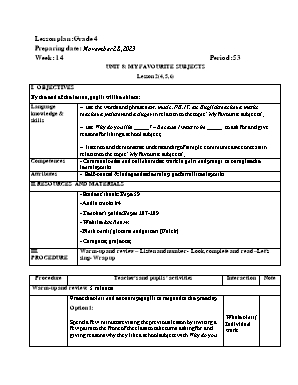
 Lesson plan: Grade 4
 Preparing date: November 28,2023
 Week: 14 Period: 53
 UNIT 8: MY FAVOURITE SUBJECTS
 Lesson 2(4,5,6)
I. OBJECTIVES
By the end of the lesson, pupils will be able to:
Language – use the words and phrases art, music, PE, IT, an English teacher, a maths
knowledge & teacher, a painter and a singer in relation to the topic “My favourite subjects”;
skills
 – use Why do you like _____? – Because I want to be _____. to ask for and give
 reasons for liking a school subject;
 – listen to and demonstrate understanding of simple communicative contexts in
 relation to the topic “My favourite subjects”;
Competences - Communication and collaboration: work in pairs and groups to complete the
 learning tasks
Attributes - Self-control & independent learning: perform listening tasks
II.RESOURCES AND MATERIALS
 - Student’s book: Page 59
 - Audio tracks 84
 - Teacher’s guide: Pages 107-109
 - Website hoclieu.vn
 - Flash cards/ pictures and posters (Unit 8)
 - Computer, projector,
III. Warm-up and review – Listen and number- Look, complete and read –Let’s
PROCEDURE sing- Wrap up
 Procedure Teacher’s and pupils’ activities Interaction Note
 Warm-up and review: 5 minutes
 Greet the class and encourage pupils to respond to the greeting.
 Option 1:
 Whole class/
 Spend a few minutes revising the previous lesson by inviting a Individual
 few pairs to the front of the class to take turns asking for and work
 giving reasons why they like a school subject with Why do you
 like ____? – Because I want to be ____.
 Option 2: ppt- Q-A with pictures
 Option 3: Ask pupils to draw anything related to their favourite
 subjects and ask their friends to guess their favourite subjects.
EXPLORATION
Activity 4. Listen and number. 5 minutes
a. Goal To listen to and understand four communicative contexts in which pupils gives
 reasons why they like the school subject, and number the correct pictures.
b. Input Picture cues:
 a. A male singer singing b. A female painter working
 c. An English teacher writingd. A maths teacher writing
 Audio script:
 1. A: Why do you like art?
 B: Because I want to be a painter.
 2. A: Why do you like maths?
 B: Because I want to be a maths teacher.
 3. A: Why do you like music?
 B: Because I want to be a singer.
 4. A: Why do you like English?
 B: Because I want to be an English teacher.
c. Outcome Pupils can listen to and understand four communicative contexts in which
 pupils gives reasons why they like the school subject, and number the correct
 pictures.
d. Procedure Step 1: Have pupils look at each picture. Elicit the favourite Whole class
 subject and the reason for liking it. Draw pupils’ attention to the Individual
 box in the bottom right hand corner of each picture. work
 Whole class
 Step 2: Play the recording of the first sentence. Tell pupils that
 they will need to pay attention to the reason why each speaker Pair work
 likes a school subject and look for it among the pictures. Ask
 pupils to listen and number the correct picture (1 for picture b). Whole class
 Play the recording again for pupils to check their answer. Pair work
 Step 3: Play the recording for pupils to listen and number the
 rest of the boxes.
 Step 4: Set a time limit for pupils to swap books with their
 partners and check their
 answers before checking as a class. Correct their answers, where
 necessary.
 Step 5: Play the recording again for pupils to double-check their
 answers if necessary.
 Key: 1. b 2. d 3. a 4. c
 Extension: If time allows, play the recording, sentence by
 sentence, for pupils to listen and repeat individually and in
 chorus. Correct their pronunciation where necessary.
e. Assessment - Performance products: Pupils’ answers.
 - Assessment tools: Observation; Questions & Answers.
KNOWLEDGE CONSTRUCTION
Activity 5. Look, complete and read. 10 minutes
a. Goal To complete two dialogues about their favourite subjects and the reasons why
 pupils like them with the help of picture cues.
b. Input Two picture cues with two gapped dialogues to complete.
c. Outcome Pupils can complete two dialogues about their favourite subjects and the
 reasons why they like them with the help of picture cues.
d. Procedure Step 1: Have pupils look at Picture 1. Ask them what the girl Whole
 and the boy are doing in the picture. Elicit the missing words class/
 from the Exchange 1 (Why, painter). Repeat the same procedure Individual
 with Picture 2. work
 Individual
 Step 2: Set a time limit for pupils to do the task individually. work
 Step 3: Get pupils swap books with their partners and check the Whole class
 answers before
 Whole class
 checking as a class. Correct their answers, where necessary.
 Extension: If time allows, invite a few pairs to stand up and
 read the sentences aloud.
e. Assessment - Performance products: Pupils’ answers.
 - Assessment tools: Observation; Questions & Answers.
PRACTICE
Activity 6. Let’s play. Whispering game 8 minutes
 a. Goal To review asking for and giving reasons for liking a subject by playing the
 game Whispering.
b. Input A picture cue: the teacher conducting two teams of pupils playing the game.
 The teacher giving a message written on a slip of paper to each first player of
 each line.
c. Outcome Pupils can review asking for and giving reasons for liking a subject by playing
 the game Whispering.
d. Procedure Step 1: The teacher prepares a few slips of paper, on each Whole
 written a message which can be a sentence or a question about a class/
 favourite subject or the reason for liking a subject. Individual
 work
 Step 2: Divide players into two lines of five or six. When the Whole
 game begins, the teacher whispers the message on a slip of paper class/
 to the first player of each line and gives the paper to him/her for Individual
 checking later if necessary. As long as the teacher finishes with work
 all the lines, he/she says aloud: Go! The first player of each line
 Pair work
 begins to whisper the message to the second player, and the
 second player passes the message to the third until it reaches the
 last player of the line. Then the last player writes the message on Pair work
 a slip of paper to hand in for checking. If the message is correct,
 the team gets one point and the message is read aloud by the
 team. The team with the most points is the winner.
 Step 3: Give pupils time to play the game for several rounds.
 The teacher moves around the class to check and offer help
 where necessary.
 Step 4: When the game is over, all the messages are written on
 board for the class to ask for and give reason for liking a subject.
e. Assessment - Performance products: Pupils’ answers.
 - Assessment tools: Observation; Questions & Answers.
Fun corner and wrap-up: 5 minutes
 Option 1:ppt
 Option 2: Guess who?
 Call some pupils to write down or draw their favourite subject, Whole
 class/
 describe the word/ drawing and ask the rest to guess the subject
 and who likes it.
 Option 3: “We can READ you” game
 collect all questions in the unit from lesson 1 to this period,
 call one pupil, ask him or her to pick up randomly a friend to ask
 questions from the list, the whole class guesses his favourite
 subject basing on his/ her answer. Remind the interviewee to
 invent their favourite subject to make the game more fun.
 D. ADJUSTMENTS (if necessary):
 .
 .....
 Week: 14 Period: 54
 UNIT 8: MY FAVOURITE SUBJECTS
 Lesson 3 (1,2,3)
I. OBJECTIVES
By the end of the lesson, pupils will be able to:
Language - correctly pronounce the sounds of the letters ke and te in isolation, in the
knowledge & words like and write, and in the sentences I like English. and Let's write.;
 skills – use the words and phrases art, music, PE, IT, an English teacher, a maths
 teacher, a painter and a singer in relation to the topic “My favourite subjects”;
 – use Why do you like _____? – Because I want to be _____. to ask for and give
 reasons for liking a school subject;
 – listen to and demonstrate understanding of simple communicative contexts
 in relation to the topic “My favourite subjects”;
Competences - Communication and collaboration: work in pairs and groups to complete the
 learning tasks
Attributes - Self-control & independent learning: perform listening tasks
II.RESOURCES AND MATERIALS
 - Student’s book: Page 60
 - Audio tracks 85. 86, 87
 - Teacher’s guide: Pages 99-111
 - Website hoclieu.vn
 - Flash cards/ pictures and posters (Unit 8)
 - Computer, projector,
III. Warm-up and review – Listen and repeat- Listen and circle- Let’s chant –
PROCEDURE Wrap up
 Procedure Teacher’s and pupils’ activities Interaction Note
 Warm-up and review: 5 minutes
 Greet the class and encourage pupils to respond to the greeting.
 Spend a few minutes revising the previous lesson by inviting
 a few pairs to ask for and give reasons why they like a Whole class/
 school subject. Individual
 work
 Option 1: lip- reading game
 guide pupils to pronounce without making sound
 divide them into groups
 each pupil takes turns to pronounce without making sound while
 the rest guess the sound
 Option 2: ppt
 EXPLORATION
Activity 1. Listen and repeat. 5 minutes
a. Goal To correctly repeat the sounds of the letters ke and te in isolation, in the
 words like and write, and in the sentences I like English. and Let's write.
 with the correct pronunciation and intonation.
b. Input – The letter ke, the word like and the sentence I like English. – The letters
 te, the word write and the sentence Let's write.
c. Outcome Pupils can correctly repeat the sounds of the letters ke and te in isolation,
 in the words like and write, and in the sentences I like English. and Let's
 write. with the correct pronunciation and intonation.
d. Procedure Step 1: Have pupils look at the letters ke, listen to the Whole class
 recording and repeat the letters until they feel confident.
 Correct the pronunciation where necessary. Individual
 work
 Step 2: Have pupils point at the word like, listen to the
 recording and repeat the word until they feel confident.
 Monitor the activity and offer help where necessary.
 Step 3: Get pupils to point at the sentence I like English, Whole class
 listen to the recording and repeat it several times. Then Pair work
 invite a few pupils to stand up, listen to and repeat the
 sentence.
 Whole class
 Step 4: Repeat Steps 1 to 3 for the letters te, the word and Pair work
 the sentence in line 2. Go around the classroom and correct
 the pronunciation where necessary.
 Step 5: Give pupils a time limit to practise pronouncing the
 letters, saying the words, and reading the sentences in pairs
 or groups.
e. Assessment - Performance products: Pupils’ answers.
 - Assessment tools: Observation; Questions & Answers.
KNOWLEDGE CONSTRUCTION
Activity 2. Listen and circle. 10 minutes
a. Goal To identify the target words like and write while listening.
b. Input Two sentences, each with three options to choose Audio script:
 1. I like music.
 2. I write in English.
c. Outcome Pupils can identify the target words like and write while listening.
 d. Procedure Step 1: Tell pupils that they are going to listen to the Whole
 recording and circle the correct options. Get them to read the class/
 options and guess the sentences they may hear in the Individual
 recording. work
 Individual
 Step 2: Play the recording for pupils to listen. Play the work
 recording again for pupils to listen and circle the correct Whole class
 options.
 Whole
 Step 3: Tell pupils to swap books with a partner, then check class/
 the answers together as a class. Write the correct answers on Individual
 the board. work
 Step 4: Play the recording again for pupils to double-check
 their answers. Extension: Invite one or two pupils to stand
 up, listen to and repeat the sentences.
 Key: 1. a 2. c
e. Assessment - Performance products: Pupils’ answers.
 - Assessment tools: Observation; Questions & Answers.
PRACTICE
Activity 3. Let’s chant. 8 minutes
a. Goal To say the chant with the correct pronunciation and rhythm.
b. Input The lyrics and recording of the chant.
c. Outcome Pupils can say the chant with the correct pronunciation and rhythm.
d. Procedure Step 1: Have pupils scan the first stanza of the chant, and Whole
 elicit the word ending with ke (like). Check pupils’ class/
 comprehension of first stanza of the chant. Individual
 work
 Step 2: Play the recording. Get pupils to listen to and repeat Whole
 the first stanza, line by line. Show them how to chant and class/
 clap their hands. Individual
 work
 Step 3: Play the recording of the first stanza again for pupils Pair work
 to do choral and individual repetition.
 Step 4: Repeat Steps 1 to 3 for the second stanza of the Pair work
 chant. Go around the classroom and offer help where
 necessary.
 Extension: If there is enough time, split the class into two
 groups to take turns chanting and clapping their hands. Each
 of the groups should sing one verse of the chant. Then invite
 some groups to the front of the class to chant and clap hands.
 Praise pupils if they perform well.
e. Assessment - Performance products: Pupils’ answers.
 - Assessment tools: Observation; Questions & Answers.
Fun corner and wrap-up: 5 minutes
 Option 1: Play the game from
 https://www.gamestolearnenglish.com/spelling-bee/ Whole
 Option 2: Cross-word game class/
 Option 3: ppt
 D. ADJUSTMENTS (if necessary):
 .
 .....
 Week: 14 Period: 55
 UNIT 8: MY FAVOURITE SUBJECTS
 Lesson 3 (1,2,3)
I. OBJECTIVES
 By the end of the lesson, pupils will be able to:
Language – use Why do you like _____? – Because I want to be _____. to ask for and give
knowledge & reasons for liking a school subject;
skills
 – listen to and demonstrate understanding of simple communicativecontexts
 in relation to the topic “My favourite subjects”;
 – read and write about someone’s favourite subject;
 – do a survey on their classmates’ favourite subjects and the reasons why they
 like these subjects and present it to their classmates at Project time in Lesson
 3.;.
Competences - Communication and collaboration: work in pairs and groups to complete the
 learning tasks
Attributes - Self-control & independent learning: perform listening tasks
II.RESOURCES AND MATERIALS
 - Student’s book: Page 61
 - Teacher’s guide: Pages 111, 112
 - Website hoclieu.vn
 - Flash cards/ pictures and posters (Unit 8)
 - Computer, projector,
III. Warm-up and review – Read and complete- Let’s write- Project – Wrap up
PROCEDURE
 Procedure Teacher’s and pupils’ activities Interaction Note
 Warm-up and review: 5 minutes
 Option 1:Greet the class and encourage pupils to respond to the
 greeting. Spend a few minutes revising the previous lesson
 by inviting two groups of three to the front of the class to
 take turns saying the two verses of the chant and clapping Whole class/
 their hands. Individual
 work
 Option 2: Chanting competition:
 play the audio 87 and pick up some volunteers to chant, the rest
 vote for the better singer.
 Option : ppt
 EXPLORATION
Activity 4. Read and complete. 5 minutes
a. Goal To read a paragraph and decide whether the sentences are true or false.
b. Input – A paragraph about Peter and his school subjects
 – Four sentences with True and False boxes.
c. Outcome Pupils can read a paragraph and decide whether the sentences are true or
 false.
d. Procedure Step 1: Have pupils read all the sentences under the Whole class
 paragraph. Tell them to read Sentence 1 and pay attention to
 the keywords name and Peter, then scan the paragraph for Individual
 the information. If it is the same, they should put a tick in the work
 True box. If the information is not the same, they should put
 a tick in the False box.
 Whole class
 Step 2: Repeat Step 1 for Sentences 2, 3 and 4. Set a time Pair work
 limit for pupils to do the activity independently. Go around
 the classroom and offer help where necessary.
 Step 3: Get pupils to swap books with their partners and
 check their answers before checking as a class.
 Step 4: Invite some pupils to stand up and read the
 paragraph aloud.
 Key: 1. True 2. False 3. True 4. False
e. Assessment - Performance products: Pupils’ answers.
 - Assessment tools: Observation; Questions & Answers.
KNOWLEDGE CONSTRUCTION
Activity 5. Let’s write. 10 minutes
a. Goal To read, understand and complete a paragraph about their favourite
 subjects.
b. Input An incomplete paragraph with four gaps.
c. Outcome Pupils can read, understand and complete a paragraph about their
 favourite subjects.
d. Procedure Step 1: Tell pupils what they are going to do. Then get them Whole
 to read the incomplete paragraph. Elicit what the paragraph class/
 is about (someone’s favourite subject and the reason why he Individual
 / she likes it). Remind them to pay attention to the context work
 (the words before and after the blanks) in the sentences Individual
 before completing them with appropriate information. work
 Whole class
 Step 2: Get pupils to fill the first gap with their name as an
 example. Whole
 Step 3: Set a time limit for pupils to complete the paragraph class/
 independently. Go around Individual
 work
 the classroom and offer help where necessary. Pair work
 Step 4: Get pupils to swap books with their partners and
 check the answers in pairs or groups before inviting a few
 pupils to stand up and read their writing aloud.
 Extension: Invite a few pupils to read their completed texts in
 front of the class.
e. Assessment - Performance products: Pupils’ answers.
 - Assessment tools: Observation; Questions & Answers.
PRACTICE
Activity 6. Project. 8 minutes
a. Goal To do a survey on their classmates’ favourite subjects and the reasons why
 they like these subjects and present them to the class
b. Input Picture: Mary presenting the result of her survey of favourite subjects to
 the class.
c. Outcome Pupils can do a survey on their classmates’ favourite subjects and the
 reasons why they like these subjects and present them to the class.
d. Procedure Step 1: Get pupils to work in groups to show their surveys Whole
 on their classmates’ favourite subjects and the reasons why class/
 they like these subjects which they have prepared at home as Individual
 homework. They will tell the class about their avourite work
 subjects and the reasons why they like them. Whole
 class/
 Step 2: Invite a pupil to the front of the class to model the Individual
 presentation. Observe and offer help with the presentation work
 language where necessary. Put the key presentation Pair work
 language on the board e.g. Look at Bill. His favourite subject is
 maths. He likes it because he wants to be a maths teacher.
 Have the pupils repeat the language a few times to help them Pair work
 feel confident when they present the project before an
 audience.
 Step 3: Set a time limit for pupils to present the project in
 their groups Each pupil shows his / her survey to the group
 and describes his / her classmates’ favourite subjects and the
 reasons why they like them.
 Step 4: Invite a few pupils to the front of the class to present
 their projects. Encourage the class to cheer the presenters.
e. Assessment - Performance products: Pupils’ answers.
 - Assessment tools: Observation; Questions & Answers.
Fun corner and wrap-up: 5 minutes
 Option 1: Play the game
 Option 2: singing along with TPR
 say some subjects, using TPR technique to guide pupils how to Whole
 sing with TPR class/
 individuals/
 Random pupils are called to sing without sound. groups
 The rest can guess the name of the subject or job
 Option 3: ppt
 D. ADJUSTMENTS (if necessary):
 .
 .....
 ...
 ....
 Week: 14 Period: 56
 UNIT 9: OUR SPORTS DAY
 Lesson 1 (1,2,3)
 I. OBJECTIVES
 By the end of the lesson, pupils will be able to:
 Language - use the words and phrase December, July, June, November, October,
knowledge & September, sports day in relation to the topic "Our sports day";
skills - use Is your sports day in _____? – Yes, it is. / No, it isn’t. It’s in _____. to
 ask and answer questions about sports days;
 - use When's your sports day? – It's in _____. to ask and answer questions
 about when a sport day is;
 - listen to and demonstrate understanding of simple exchanges in relation
 to the topic "Our sports day";
Competences - Communication and collaboration: work in pairs and groups to complete the
 learning tasks
 - Self-control & independent learning: perform listening tasks
Attributes - Develop their interests in sports and show their responsibility by raising
 awareness of time and date.
II. RESOURCES AND MATERIALS
 - Student’s book: Page 62
 - Audio tracks 88, 89
 - Teacher’s guide: Pages 113, 114, 115
 - Website hoclieu.vn
 - Flash cards/ pictures and posters (Unit 9)
 - Computer, projector,
III. Warm-up and review – Look, listen and repeat – Listen, point and say –
PROCEDURE Let’s talk – Fun corner and wrap-up
Procedure Teacher’s and pupils’ activities Interaction Note
Warm-up and review: 5 minutes
 Greet the class.
 Option 1: Whole
 class/
 - Have some pupils say the chant from Lesson 3 of Unit 8.
 Individual
 Praise them and get the class to cheer or clap if they do a
 work
 good job.
 - Ask pupils to open their books at page 62 and look at
 Unit 9, Lesson 1, Activity 1. Write the title “Our sports
 day” on the board and read it for the class to repeat a few
 times. Tell pupils what they will learn in this lesson.
 Option 2:
 - Have pupils listen and sing the song “Months of the
 Year”.
EXPLORATION
Activity 1. Look, listen and repeat. 5 minutes
a. Goal To understand and correctly repeat the sentences in two communicative
 contexts focusing on asking and answering questions about sports days.
b. Input – Context a:
 Lucy: Our sports day is in May. We play many sports and games.
 Nam: Great! I like sports.
 – Context b:
 Lucy: Is your sports day in May too?
 Nam: No, it isn't. It's in April.
c. Outcome Pupils can understand and correctly repeat the sentences in two
 communicative contexts focusing on asking and answering questions
 about sports days.
 d. Procedure Step 1: Have pupils look at Pictures a and b and identify Whole
 the characters in the pictures (see Input). class/
 Individual
 Step 2: Ask pupils to look at Picture a. Play the recording
 work
 for them to listen. Play the recording again, sentence by
 sentence, for pupils to listen and repeat. Repeat the same
 procedure with Picture b. Correct their pronunciation where
 necessary.
 Step 3: Play the recording again for pupils to listen to and
 repeat individually and / or in chorus sentence by sentence.
 Step 4: Invite a few pairs to the front of the classroom to
 listen to and repeat the sentences in the recording. Pair work
 Whole
 Step 5: Draw their attention to the question Is your sports class/
 day in May too? and the answer No, it isn't. It's in April. Individual
 Tell pupils that they are used to ask and answer questions work
 about sports days.
e. - Performance products: Student’s answers
Assessment
 - Assessment tools: Observation; Questions & Answers
KNOWLEDGE CONSTRUCTION
Activity 2. Listen, point and say. 10 minutes
a. Goal To correctly say the words and use Is your sports day in ______? – Yes,
 it is. / No, it isn’t. It’s in ______. to ask and answer questions about sports
 days.
 b. Input – Picture cues:
 a. a calendar sheet of April b. a calendar sheet of May
 c. a calendar sheet of June d. a calendar sheet of July
 – Speech bubbles:
 Is your sports day in ______? – Yes, it is. / No, it isn’t. It’s in ______.
 Audio script:
 a. April / Yes b. May / Yes
 c. April / No / June d. May / No / July
 a. A: Is your sports day in April?
 B: Yes, it is.
 b. A: Is your sports day in May?
 B: Yes, it is.
 c. A: Is your sports day in April?
 B: No, it isn’t. It’s in June.
 d. A: Is your sports day in May?
 B: No, it isn’t. It’s in July.
c. Outcome Pupils can correctly say the words and use Is your sports day in
 ______? – Yes, it is. / No, it isn’t. It’s in ______. to ask and answer
 questions about sports days.
 d. Procedure Step 1: Have pupils look at the pictures and elicit the Whole
 names of the months in the pictures. Have the class repeat class/
 the words a few times. Check comprehension. Individual
 work
 Step 2: Have pupils point at Picture a, listen to the
 recording and repeat the word (April). Have the class
 repeat the word a few times. Repeat the same procedure
 with the other three pictures.
 Step 3: Point at the bubbles and have pupils listen to and
 repeat after the recording Is your sports day in April? –
 Yes, it is. Point at Picture a and have pupils listen to and
 repeat the sentences until they feel confident. Repeat the
 same procedure with Pictures b, c and d.
 Step 4: Have pupils work in pairs and practise asking and Pair work
 answering the question Is your sports day in ______? –
 Yes, it is. / No, it isn't. It's in ______., using speech
 bubbles and Pictures a, b, c and d.
 Step 5: Invite a few pairs to point at the pictures and say Whole
 the questions and answers in front of the class. class/ Pair
 work
e. - Performance products: Student's talks and interaction
Assessment
 - Assessment tools: Observation; Answer keys
PRACTICE
Activity 3. Let’s talk. 8 minutes
a. Goal To enhance the correct use of Is your sports day in ______? – Yes, it is. /
 No, it isn’t. It’s in ______. to ask and answer questions about sports days.
b. Input – Picture cue: a picture of a sports day and calendar sheets of the months
 of the year
 – Speech bubbles: Is your sports day in ______? – ______.
c. Outcome Pupils can enhance the correct use of Is your sports day in ______? –
 Yes, it is. / No, it isn’t. It’s in ______. to ask and answer questions about
 sports days.
 d. Procedure Step 1: Draw pupils’ attention to the picture. Have them Whole
 say the names of the months in the picture. Ask questions class/
 to help them identify the context (see Input). Individual
 work
 Step 2: Have pupils look at the bubbles to understand how
 the sentence pattern is used. Have pupils role-play to
 practise asking the questions and giving their answers in
 pairs, using picture cues. Make sure pupils understand the
 structure and say them with the right pronunciation and
 intonation. Go around to observe and provide help.
 Step 3: Invite some pupils to practise asking and answering
 questions in front of the class. Praise them if they perform
 well.
 Extension: For a more able class, have pupils ask and
 answer questions about what their friend(s) do on school
 sports day, using the structure learnt e.g. What do you do on
 sports day? – I ______.
e. - Performance products: Student’s interaction and performance
Assessment - Assessment tools: Observation; Questions & Answers
Fun corner and wrap-up: 5 minutes
File đính kèm:
- giao_an_tieng_anh_4_tuan_14_period_53_nam_hoc_2023_2024.docx


