

Giáo án Tiếng Anh 4 - Tuần 4 - Năm học 2023-2024 - Lê Khánh Ly
Step 1: Tell pupils the goal of the activity and explain that they should read the sentences and tick True or False. Check comprehension.
Step 2: Do Sentence 1 as an example. First, have pupils read the sentence and identify Minh’s age. Then have them read the text and find the correct information to tick the appropriate box.
Step 3: Set a time limit for pupils to do the task independently. Go around the classroom and offer help if necessary.
Step 4: Get pupils to swap their books with a partner and check their answers before checking as a class. Correct the answers where necessary.
Extension: Invite one or two pupils to read the text and the sentences in front of the class. You may ask pupils to correct the false sentences if necessary.
 17 trang
31/03/2026
4680
17 trang
31/03/2026
4680
Tóm tắt nội dung tài liệu: Giáo án Tiếng Anh 4 - Tuần 4 - Năm học 2023-2024 - Lê Khánh Ly
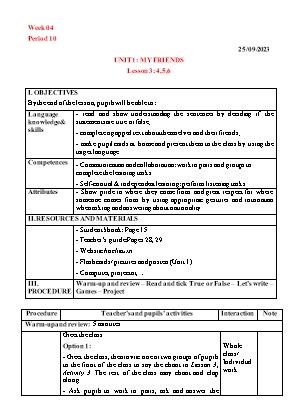
Week 04
Period 10
 25/09/2023
 UNIT 1: MY FRIENDS
 Lesson 3: 4,5,6
I. OBJECTIVES
By the end of the lesson, pupils will be able to:
Language - read and show understanding the sentences by deciding if the
knowledge & statements are true or false;
skills - complete a gapped text about themselves and their friends;
 - make pupil cards at home and present them to the class by using the
 target language.
Competences - Communication and collaboration: work in pairs and groups to
 complete the learning tasks.
 - Self-control & independent learning: perform listening tasks.
Attributes - Show pride in where they come from and great respect for where
 someone comes from by using appropriate gestures and intonation
 when asking and answering about nationality.
II. RESOURCES AND MATERIALS
 - Student’s book: Page 15
 - Teacher’s guide: Pages 28, 29
 - Website hoclieu.vn
 - Flash cards/ pictures and posters (Unit 1)
 - Computer, projector,
III. Warm-up and review – Read and tick True or False – Let’s write –
PROCEDURE Games – Project
Procedure Teacher’s and pupils’ activities Interaction Note
Warm-up and review: 5 minutes
 Greet the class.
 Option 1: Whole
 - Greet the class, then invite one or two groups of pupils class/
 to the front of the class to say the chant in Lesson 3, Individual
 Activity 3. The rest of the class may chant and clap work
 along.
 - Ask pupils to work in pairs, ask and answer the
 questions Where  from? -  from  Group
 Option 2: Backward spelling work
 - T divides class into teams.
 - Each team takes turns to have a pupil stand in front of
 the board.
 - The rest pupils spell the word written by the teacher on
 the board backwards.
 - The team that guesses the word first gets 1 point. The
 team with the most points is the winner.
 Ex: N-A-P-A-J JAPAN
 M-A-N-T-E-I-V VIETNAM
 E-R-O-P-A-G-N-I-S SINGAPORE
PRACTICE
Activity 4. Read and tick True or False. 5 minutes
a. Goal To read and show understanding the sentences by deciding if the
 statements are true or false.
b. Input - A short text about Minh and his two new friends Tony and Laura
 - Four sentences with True and False boxes under the text
c. Outcome Pupils can read and show understanding of the sentences by deciding
 if the statements are true or false.
 Key: 1. True 2. True 3. False 4. False
d. Step 1: Tell pupils the goal of the activity and explain Whole
Procedure that they should read the sentences and tick True or False. class/
 Check comprehension. Individual
 work
 Step 2: Do Sentence 1 as an example. First, have pupils
 read the sentence and identify Minh’s age. Then have
 them read the text and find the correct information to tick
 the appropriate box.
 Step 3: Set a time limit for pupils to do the task
 independently. Go around the classroom and offer help if
 necessary.
 Step 4: Get pupils to swap their books with a partner and
 check their answers before checking as a class. Correct Pair work
 the answers where necessary.
 Extension: Invite one or two pupils to read the text and
 the sentences in front of the class. You may ask pupils to
 correct the false sentences if necessary.
e. - Performance products: Pupil’s answers
Assessment - Assessment tools: Observation; Questions & Answers, Peer
 correction
PRODUCTION
Activity 5. Let’s write. 8 minutes
a. Goal To complete a gapped text about themselves and their friends.
b. Input A short gapped text
c. Outcome Pupils can complete a gapped text about themselves and their
 friends.
d. Step 1: Tell the class the goal of the activity and explain Whole
Procedure that they should read the gapped text and fill in the gaps class/
 with their own information. Explain that the gaps in the Individual
 text focus on their names and age(s), their friends’ names work
 and where they are from. Check comprehension.
 Step 2: Have pupils do the first gapped sentence together Individual
 as an example. Ask them to read the sentence and elicit work
 the names. Then have them write their names in the gap.
 Step 3: Give pupils time to complete the text
 independently. Go around the classroom and offer help if
 necessary.
 Pair work
 Step 4: Get pupils to swap their books with a partner and
 check their answers before checking as a class.
 Individual
 Extension: Invite one or two pupils to read their
 work
 completed texts in front of the class.
e. - Performance products: Pupil's answer
Assessment - Assessment tools: Observation; Answer keys
Games: 5 minutes
 Option 1: Game Find the treasure
 - Teacher divides the class into 2 teams (boys and girls).
 - Each team takes turns to choose the flag and answer the question.
 - The team that has more points is the winner.
 Option 2: Hot potato
 - Teacher prepares a small ball and some cards with a name, a number
 (age) and a country on them.
 - Teacher plays the music and pupils start to pass the ball. The pupil
 who holds the ball when the music stops picks a card and makes
 sentences:  is  years old. She is from
 Linda/ 8 / Britain Linda is eight years old. She is from Britain.
PRODUCTION
Activity 6. Project 10 minutes
a. Goal To make pupil cards at home and present them to the class by using
 the target language
b. Input The pupil cards of two pupils in Unit 1. The cards contain the pupils’
 names, ages, and where they are from
c. Outcome Pupils can make pupil cards at home and present them to the class by
 using the target language.
d. Step 1: Tell pupils the goal of the activity. Explain that Group
Procedure they have to show the two pupil cards that they have work/
 prepared at home and present them to the class. Pair work
 Step 2: Have pupils work in groups of five. Each pupil Pair work
 shows his / her pupil cards and tells the group about them,
 e.g. This is Alice. She’s nine years old. She’s from Britain.
 And this is Bob. He’s ten years old. He’s from Australia.
 Go around the classroom and offer help if necessary.
 Step 3: Invite a few pupils to show their cards and tell the Group
 class about them, e.g. Hi. My name’s Lan. I’m from Viet work/
 Nam. This is Alice. She’s nine years old. She’s from Pair work
 Britain. And this is Bob. He’s ten years old. He’s from
 Australia.
e. - Performance products: Student’s interaction and performance
Assessment - Assessment tools: Observation
 Week 04
 Period 11
 25/09/2023
 UNIT 2: TIME AND DAILY ROUTINES
 Lesson 1: 1,2,3
 I. OBJECTIVES
 By the end of the lesson, pupils will be able to:
 Language - understand and correctly repeat the sentences in two communicative
 knowledge & contexts focusing on asking and telling the time.
 skills - correctly say the phrases and use What time is it? – It’s _____. to ask
 and tell the time.
 - enhance the correct use of What time is it? – _____. to ask and tell the
 time in a freer context.
Competences - Communication and collaboration: work in pairs and groups to
 complete the learning tasks
 - Self-control & independent learning: perform learning tasks
Attributes Show their responsibility by noticing the time and follow the timetable
 on time.
II. RESOURCES AND MATERIALS
 - Student’s book: Page 16
 - Audio tracks 16, 17
 - Teacher’s guide: Pages 30, 31, 32
 - Website hoclieu.vn
 - Flash cards/ pictures and posters (Unit 2)
 - Computer, projector,
III. Warm-up and review – Look, listen and repeat – Listen, point, and
PROCEDUR say – Let’s talk – Fun corner and wrap-up
E
 Interactio
 Procedure Teacher’s and pupils’ activities Note
 n
 Warm-up and review: 5 minutes
 Option 1: Whole
 Sing the song What time is it? class/
 Link: Individual
 https://www.youtube.com/watch?v=0Yq_rztquuU work
 Option 2: Game: Slap the board Group
 - Divide class into 3 teams, invite 1 member from work
 each team for each turn.
 - Say the numbers for the pupils to slap and say aloud.
 - Give points to the pupils with the correct choice and
 encourage them.
 Whole
 Option 3: Sing a song from youtube
 class/
 (https://www.youtube.com/watch?v=tVlcKp3bWH8)
 Individual
 - Ask pupils to sing a song.
 work
 - Give points to the pupils and encourage them.
EXPLORATION
Activity 1. Look, listen and repeat. 5 minutes
a. Goal To understand and correctly repeat the sentences in two
 communicative contexts focusing on asking and telling the time.
b. Input – Context a:
 Ms Hoa: What time is it?
 Class: It’s eight thirty.
 Ms Hoa: Let’s have a break.
 – Context b:
 Bill: What time is it?
 Linh: It’s three fifteen. Let’s go into the classroom.
c. Outcome Pupils can understand and correctly repeat the sentences in two
 communicative contexts focusing on asking and telling the time.
d. Step 1: Ask pupils to look at Pictures a and b and Whole
Procedure identify the characters and the time shown on the class/
 clocks in the pictures. Individual
 Step 2: Ask pupils to look at Picture a. Play the work
 recording for them to listen.
 Step 3: Play the recording again, sentence by
 sentence, for pupils to listen and repeat individually
 and in chorus. Correct their pronunciation where
 necessary. Repeat the same procedure with Picture b.
 Step 4: Invite a few pairs to stand up to listen to and Pair work
 repeat the sentences in the recording.
 Step 5: Draw pupils’ attention to the contextual
 pictures. Tell pupils that the question What time is it?
 and the answers It’s eight thirty. and It’s three fifteen.
 are used to ask and tell the time.
e. - Performance products: Student’s answers
Assessment - Assessment tools: Observation; Questions & answers
KNOWLEDGE CONSTRUCTION
Activity 2. Listen, point and say. 10 minutes
a. Goal To correctly say the phrases and use What time is it? – It’s _____.
 to ask and tell the time.
b. Input – Picture cues:
 a. a clock showing 6:00 AM b. a clock showing 6:15 AM
 c. a clock showing 6:30 PM d. a clock showing 6:45 PM
 – Speech bubbles: What time is it? – It’s _____.
 Audio script:
 a. six o’clock b. six fifteen c. six thirty d. six forty-five
 a. A: What time is it?
 B: It’s six o’clock.
 b. A: What time is it?
 B: It’s six fifteen.
 c. A: What time is it?
 B: It’s six thirty.
 d. A: What time is it?
 B: It’s six forty-five.
c. Outcome Pupils can correctly say the phrases and use What time is it? – It’s
 _____. to ask and tell the time.
d. Step 1: Have pupils look at the pictures. Elicit the Whole
Procedure time on the clocks. Spend a few minutes explaining class/
 how to tell the time. Give the meaning of a.m. and Individual
 p.m., and when to say o’clock in telling the time. work
 Note: a.m. is used to tell the time in the morning, from
 00:00 to 12:00; p.m. is used to tell the time in the
 afternoon and evening (afternoon is from 12:00:01 to
 17:00 or 18:00, and evening is from 17:00 or 18:00 to
 23:59:59).
 Step 2: Have pupils point at Picture a (6:00 AM),
 listen to the recording and repeat. Repeat the same
 procedure with Pictures b, c and d. Have the class
 point at the pictures and repeat the time a few times.
 Step 3: Point at the first bubble and have pupils listen
 to and repeat after the recording (What time is it?).
 Point at Picture a and have pupils listen to and repeat
 after the recording (It’s six o’clock.). Repeat the same
 procedure with Pictures b, c and d.
 Step 4: Set a time limit for pupils to work in pairs to
 practise asking and answering the question What time
 is it? – It’s _____.
 Step 5: Invite a few pairs to the front of the class to Pair work
 take turns pointing at the pictures and saying the
 questions and answers.
e. - Performance products: Student's talks and interaction
Assessment - Assessment tools: Observation; Answer keys
PRACTICE
Activity 3. Let’s talk. 8 minutes
a. Goal To enhance the correct use of What time is it? – _____. to ask and
 tell the time in a freer context.
b. Input – Picture cue: Two pupils ask and tell the time shown on different
 clocks: 7:00 AM, 8:15 AM, 2:30 PM and 4:45 PM.
 – Speech bubbles: What time is it? – _____.
c. Outcome Pupils can enhance the correct use of What time is it? – _____. to
 ask and tell the time in a freer context.
d. Step 1: Draw pupils’ attention to the two speech Whole
Procedure bubbles. Read the question aloud and ask pupils to class/
 repeat it. Ask them to look at the second bubble and Individual
 identify what the answer should be. Elicit the answer: work
 It's seven o’clock. Get pupils to repeat the questions
 and answers several times.
 Step 2: Set a time limit for pupils to work in pairs,
 point at the different clocks in the picture, ask and tell
 the time using What time is it? – _____. Go around
 Whole
 the classroom to observe and offer help where
 class/ Pair
 necessary.
 work
 Step 3: Invite some pairs to ask and tell the time in
 front of the class.
e. - Performance products: Student’s interaction and performance
Assessment - Assessment tools: Observation; Questions & answers
Fun corner and wrap-up: 5 minutes
 Option 1: Game: Dart board (ppt) Group
 Pupils answer the correct answers with the score, if work
 not the
 arrow will fall down (They cannot get the score for
 that
 question).
 Option 2: Game: Sentence Puzzle
 Divide the class into groups of four. Give each group
 a sentence that is broken/ cut into pieces. Ask the
 pupils to arrange them to make a complete sentence,
 then read it aloud.
 Whole
 Option 3:
 class
 Ask students to answer the following question:
 What have you learnt from the lesson today?
 (- Use the words at, fifteen, forty-five, o’clock, thirty
 in relation to the topic Time and daily routines to talk
 about the time.
 - Use sentence pattern What time is it? – It’s _____.
 to ask
 and tell the time.)
 * Preparation for the project:
 Tell pupils about the project on page 21. Ask them to
 prepare for it at home by drawing some pictures in
 relation to their daily routines. Remind pupils to bring
 their pictures to the class at Project time in Lesson 3.
Week 04
Period 12
 26/09/2023
 UNIT 2: TIME AND DAILY ROUTINES
 Lesson 1: 4,5,6
I. OBJECTIVES
By the end of the lesson, pupils will be able to:
Language - listen to and understand two communicative contexts in which two
knowledge & pupils play a game asking and telling the time and tick the correct
skills pictures.
 - complete four gapped exchanges with the help of picture cues.
 - review telling the time by playing the game Which clock says ...?
Competences - Communication and collaboration: work in pairs and groups to
 complete the learning tasks
 - Self-control & independent learning: perform learning tasks
Attributes - Show their responsibility by noticing the time and follow the timetable
 on time.
II. RESOURCES AND MATERIALS
 - Student’s book: Page 17
 - Audio track 18
 - Teacher’s guide: Pages 32, 33, 34
 - Website hoclieu.vn
 - Flash cards/ pictures (Unit 2)
 - Computer, projector,
III. Warm-up and review – Listen and tick – Look, complete and read –
PROCEDUR Let’s play – Fun corner and wrap-up
E
 Procedur
 Teacher’s and pupils’ activities Interaction Note
 e
Warm-up and review: 5 minutes
 Option 1: Whole
 Sing the song What time is it? class/
 Individual
 Link: work
 https://www.youtube.com/watch?v=0Yq_rztquuU
 Option 2: Game: Slap the board (ppt)
 Use the vocabulary from the previous lesson. Have Group
 students stand in 2 rows of 5 or more pupils and take work
 turns to slap the board. Give the points to the team with
 the faster and correct answers.
 Option 3: Game: Who’s faster?
 - Divide the class into 2 teams.
 - Have children look at the pictures on the screen and
 shout out the numbers which are hidden.
 - Give points to the team with the faster and correct
 answers.
PRACTICE
Activity 4. Listen and tick. 5 minutes
a. Goal To listen to and understand two communicative contexts in which
 two pupils play a game asking and telling the time and tick the
 correct pictures.
b. Input Picture cues:
 1a. a clock showing 9:00 AM 1b. a clock showing 9:15 AM
 2a. a clock showing 4:00 PM 2b. a clock showing 4:30 PM
 Audio script:
 1. A: Let’s play a game.
 B: OK!
 A: Look. What time is it?
 B: It’s nine fifteen.
 A: Very good!
 2. A: Now what time is it?
 B: It’s four o’clock.
 A: No it isn’t. It’s four thirty.
c. Pupils can listen to and understand two communicative contexts in
Outcome which two pupils play a game asking and telling the time and tick the
 correct pictures.
 Key: 1. b 2. b
d. Step 1: Draw pupils’ attention to the pictures and ask Whole
Procedure them to identify the time on the clocks. class/
 Step 2: Play the recording of the first dialogue for Individual
 pupils to listen and tick the correct picture. Play the work
 recording again for pupils to listen and check their
 answers. Praise pupils if they have the correct answer
 (Picture 1b).
 Step 3: Repeat Step 2 with the second dialogue. Pair work
 Step 4: Set a time limit for pupils to swap books with a
 partner to check their answers in pairs before checking Whole
 as a class. class/
 Extension: If time allows, play the recording, sentence Individual
 by sentence, for the class to listen and repeat work
 individually and in chorus. Correct their pronunciation
 where necessary.
e. - Performance products: Student’s answers
Assessmen - Assessment tools: Observation; Questions & Answers, Peer
t correction
PRACTICE
Activity 5. Look, complete and read. 10 minutes
a. Goal To complete four gapped exchanges with the help of picture cues.
b. Input Four picture cues and four gapped exchanges to complete
c. Pupils can complete four gapped exchanges with the help of picture
Outcome cues.
 Key: 1. ten 2. is it 3. What time; thirty 4. What time; four forty-five
d. Step 1: Ask pupils to look at the pictures and identify Whole
Procedure the time on the four clocks. class/
 Step 2: Ask pupils to look at each gapped exchange. Individual
 Draw their attention to the missing words and time. work
 Remind them to complete the answers using words, not
 numbers. Individual
 Step 3: Have pupils look at Picture 1. Ask them what is work
 missing in the answer (ten). Then have them complete
 the gap (It’s ten o’clock.). Repeat the same procedure
 with Pictures 2, 3 and 4.
 Individual
 Step 4: Set a time limit for pupils to complete the work/ Pair
 gapped exchanges individually, then invite a few pairs to work
 stand up to ask and tell the time on the clock faces.
e. - Performance products: Student's talks and interaction
Assessmen - Assessment tools: Observation; Answer keys
t
PRACTICE
Activity 6. Let’s play. 8 minutes
a. Goal To review telling the time by playing the game Which clock says ...?
b. Input A picture shows two pupils playing the game. Minh says It’s five
 fifteen. Mary finds the clock showing the time, points at it and says
 It’s clock F!
c. Pupils can review telling the time by playing the game Which clock
Outcome says ...?
d. Step 1: Tell pupils that they are going to play a game Group
Procedure that involves finding and saying which clock shows the work/ Pair
 time told by another player. work
 Step 2: Invite two volunteers to stand in front of the
 board. Tell them to decide who is the time teller and
 who is the clock finder. Pair work
 Step 3: The time teller will tell a certain time, for
 example 5:15, for the other player to find the clock
 which shows the correct time by saying its letter. If it is Group
 correct, the correct finder will get one point. Every work/ Pair
 player has eight tries. After the first round, the time work
 teller will become the clock finder. All the clocks on the
 board are kept for later use. When the game is over, the
 player who has the most points is the winner. Encourage
 the class to cheer whenever a player gets a point.
e. - Performance products: Student’s interaction and performance
Assessmen - Assessment tools: Observation; Questions & answers
t
Fun corner and wrap-up: 5 minutes
 Option 1: Rearrange the words (ppt) Group
 Pupils take turns to rearrange the words into a complete work
 sentence.
 Option 2: Game: Sentence Puzzle
 Divide the class into groups of four. Give each group a
 sentence that is broken/ cut into pieces. Ask them to
 arrange them to make a complete sentence, then read it
 aloud.
 The group who makes it first will be the winner.
 Option 3: Game: Spin the Wheel
 - Divide the class into teams.
 - Teacher calls pupils from each team to answer the
 question What time is it?
 - Pupils/ teachers click the “spin” button to get points.
Week 04
Period 13
 27/09/2023
 UNIT 2: TIME AND DAILY ROUTINES
 Lesson 2: 1,2,3
I. OBJECTIVES
By the end of the lesson, pupils will be able to:
Language - understand and correctly repeat the sentences in two communicative
knowledge & contexts focusing on asking and answering questions about the
skills characters’ daily routines.
 - correctly say the phrases and use What time do you _____? – I _____
 at _____. to ask and answer questions about daily routines.
 - enhance the correct use of What time do you _____? - I _____ at
 ______. to ask and answer about someone’s daily routines.
Competences - Communication and collaboration: work in pairs and groups to
 complete the learning tasks
 - Self-control & independent learning: perform listening tasks
Attributes - Show their responsibility by noticing the time and follow the timetable
 on time.
II. RESOURCES AND MATERIALS
 - Student’s book: Page 18
 - Audio tracks 19, 20
 - Teacher’s guide: Pages 34, 35, 36, 37
 - Website hoclieu.vn
 - Flash cards/ pictures and posters (Unit 2)
 - Computer, projector,
III. Warm-up and review – Look, listen and repeat – Listen, point, and
PROCEDUR say – Let’s talk – Fun corner and wrap-up
E
 Procedur
 Teacher’s and pupils’ activities Interaction Note
 e
 Warm-up and review: 5 minutes
 Greet the class.
 Option 1: Whole
 Sing the song What time is it? class/
 Link: Individual
 https://www.youtube.com/watch?v=0Yq_rztquuU work/
 Group
 Option 2: Game: Which clock says ...? work
 Spend a few minutes revising the previous lesson by
 having the class play the game Which clock says ...?
 Option 3: Game: What’s missing?
 - Divide the class into 2 teams.
 - Have pupils look at the screen with numbers from 1
 to 10. Then hide 1 number each time and have the
 teams raise their hands to answer. Give points for each
 correct answer.
EXPLORATION
Activity 1. Look, listen and repeat. 5 minutes
a. Goal To understand and correctly repeat the sentences in two
 communicative contexts focusing on asking and answering questions
 about the characters’ daily routines.
b. Input – Context a:
 Minh: What time do you get up?
 Mary: I get up at six o’clock. And you?
 Minh: At five forty-five.
 – Context b:
 Mary: What time do you have breakfast?
 Minh: At six fifteen.
c. Pupils can understand and correctly repeat the sentences in two
Outcome communicative contexts focusing on asking and answering questions
 about the characters’ daily routines.
d. Step 1: Ask pupils to look at Pictures a and b and Whole
Procedure identify the time on the clocks in the pictures. class/
 Step 2: Ask pupils to look at Picture a. Play the Individual
 recording for them to listen. work
 Step 3: Play the recording again, sentence by sentence,
 for pupils to listen and repeat individually and in
 chorus. Correct their pronunciation where necessary.
 Repeat the same procedure with Picture b.
 Step 4: Invite a few pairs to the front of the class to Pair work
 listen to and repeat the sentences in the recording.
 Step 5: Draw pupils’ attention to the exchanges What Whole
 time do you get up? – I get up at six o’clock. and What class
 time do you have breakfast? – At six fifteen. Tell pupils
 that these are questions and answers about daily
 routines.
e. - Performance products: Student’s answers
Assessmen - Assessment tools: Observation; Questions & Answers
t
KNOWLEDGE CONSTRUCTION
Activity 2. Listen, point and say. 10 minutes
a. Goal To correctly say the phrases and use What time do you _____? – I
 _____ at _____. to ask and answer questions about daily routines.
b. Input – Picture cues:
 a. a girl is getting up; a clock shows 5:00 AM
 b. a boy is having breakfast; a clock shows 6:15 AM
 c. a pupil is going to school; a clock shows 1:15 PM
 d. a boy is sleeping in bed; a clock shows 9:00 PM
 – Speech bubbles: What time do you _____? – I _____ at _____.
 Audio script:
 a. five o’clock; get up b. six fifteen; have breakfast
 c. one fifteen; go to school d. nine o’clock; go to bed
 a. A: What time do you get up?
 B: I get up at five o’clock.
 b. A: What time do you have breakfast?
 B: I have breakfast at six fifteen.
 c. A: What time do you go to school?
 B: I go to school at one fifteen.
 d. A: What time do you go to bed?
 B: I go to bed at nine o’clock.
c. Pupils can correctly say the phrases and use What time do you _
Outcome ____?
 - I _______ at________. to ask and answer questions about daily
 routines.
d. Step 1: Have pupils look at the pictures and elicit the Whole
Procedure activities and the time from them. class/
 Step 2: Have pupils point at Picture a, listen to the Individual
 recording, and repeat the phrase (get up). Repeat the work
 same procedure with the other three pictures. Have the
 class repeat the phrases a few times.
 Step 3: Point at the first bubble and have pupils listen
 and repeat after the recording (What time do you get
 up?). Point at Picture a and have pupils listen and
 repeat after the recording (I get up at five o’clock.).
 Repeat the same procedure with the other three
 pictures. Pair work
 Step 4: Set a time limit for pupils to work in pairs,
 point at the pictures, and practice asking and
 answering the question What time do you _____? – I
 _____ at _____.
 Step 5: Invite a few pairs to the front of the class to
 take turns pointing at the pictures, asking and
 answering the question What time do you _____? – I
 _____ at _____.
e. - Performance products: Student's talks and interaction
Assessmen - Assessment tools: Observation; Questions & answers
t
PRACTICE
Activity 3. Let’s talk. 8 minutes
a. Goal To enhance the correct use of What time do you _____? – I _____ at
 _____. to ask and answer questions about pupils’ daily routines in a
 freer context.
b. Input - Picture cue: Nam and Lucy ask and answer questions about
 Lucy’s daily routines.
 - Speech bubbles: What time do you ____? – _________.
c. Pupils can enhance the correct use of What time do you _____? – I
Outcome _____ at _____. to ask and answer questions about their daily
 routines in a freer context.
d. Step 1: Have pupils look at the picture and explain that Whole
Procedure Nam and Lucy are asking and answering questions class/
 about Lucy’s daily routines. Get pupils to look at the Individual
 first speech bubble and point at the picture of Lucy work
 getting up to complete the question What time do you
 get up? Ask them to repeat the question. Then point at
 the answer bubble and say I get up at five o’clock. for
 pupils to repeat. Let pupils listen to and repeat the
 question and the answer a few times individually and in
 chorus. Pair work
 Step 2: Set a time limit for pairs of pupils to practise
 asking and answering the question What time do you
 _____? – I _____ at _____.
 Step 3: Go around the classroom to offer help where
 necessary. Pair work/
 Step 4: Invite some pairs of pupils to the front of the Whole
 class to take turns asking and answering questions class
 about their daily routines.
e. - Performance products: Student’s interaction and performance
Assessmen - Assessment tools: Observation; Questions & answers
t
Fun corner and wrap-up: 5 minutes
 Game: Whack the watermelon Group
 - Prepare a set of flashcards of clocks. work
 - Divide the class into 3 teams.
 - The teams take turns to send 2 pupils to go to the
 board and choose a flashcard to ask and answer about
 time, using the model sentences and the number in the
 card.
 - If they give the correct answers, they can whack a
 watermelon to get points for their teams.
 - The team with more points is the winner.
File đính kèm:
- giao_an_tieng_anh_4_tuan_4_nam_hoc_2023_2024_le_khanh_ly.docx


